DEC Websites come in many formats. They are each unique and reflect the interests and focus of their respective counties. One thing that should be uniform to all, however, is UP-TO-DATE information. Voters will review these sites and make judgments about the viability of each DEC. We encourage Democrats to contact your DEC leadership about the need to have current and timely information on your DEC website. Just for starters, here are DEC websites of TampaBay.
Manatee DEC. Up to date! Has a current events calendar. Club list well done.
Pasco DEC. Linked precinct finder-nice touch. Good navigation.
Pinellas DEC. Archived Newsletters are up-to-date.
NEEDS REVIVING.
Hillsborough DEC. Hasn't been updated for many months. Candidates listed are from Fall 2006. Elected officials are out of date.
Update from Ray (6-12: 2:25pm): From cjohnson, who is a member of the Hillsbourough DEC. He says the DEC is focusing on rebuilding themselves right now after some past troubles. According to Curt, they need volunteers to help rebuild the organization there. Email him if you're in the area, and see what you can do. We here at Reform Florida's DECs are here to help and find solutions for our friends in need.
Monday, June 11, 2007


Building Local Progressive Blogospheres
I've heard many times on Kos and MyDD, that the trend in blogging is towards the local level. This is absolutely correct. While there is still some frontier left at the state level (not in Florida though) in some portions of the country, the real possibilities lay in counties, towns, and neighborhoods. Local issues, local politicians, and local institutions need to be given the same critical analysis and research that the blogosphere has brought to the state, national, and international levels.
DECs can play a small role here. These local institutions are already home to community activists, who in turn have connections to other activists. Just 3-6 people can form the core of a wonderful local progressive blog. Of course, don't underestimate the power of one person to start a powerful local blog as well.
Individuals inside DECs should take it upon themselves to try and form a local progressive blog, which may or may not be affiliated with the local DEC. Each model has its benefits and drawbacks.
Here are some things that a good local progressive blog can do:
Raise Awareness: For candidates, community leaders, and voices of dissent, having a place to get their message out (other than the MSM) is an incredibly valuable tool. There aren't really any big media gatekeepers standing between you and the public.
Activist Recruitment: The blog world is a much different place that the DEC world. One of the funny (and awesome) things we found in the Marion DEC was that there were nearly a dozen people who were signed up on Party Builder, MyBarackObama, and OneCorps who were from Ocala/Marion County, who we had never met before! There are people in the blogosphere (and non-blog people, too) who don't even know that there is a local Democratic Party or Democratic club in their area. As a local progressive blog grows, it will naturally attract these people and funnel them into the local scene.
Hold Politicians Accountable: Accountability isn't just a scarce commodity in Washington! If you've ever spent time at the local level (particularly in Republican-held areas) - things can be just as bad - if not worse. Developers are buying off politicians, people are getting screwed, and special interests only seem to be benefiting. Sounds like a great set of posts! Rather than a DEC trying to set up something like a Government Oversight Committee to send activists to County Commission, School Board, Water Board, and City Council meetings, they can essentially outsource this critical task to the bloggers.
Push Progressive Issues: Did you know there are ways to enact public financing of elections at the municipal level? Did you know you can make your city compliant with the Kyoto protocol (here and here)? Sure you can! But why wait for the national groups to get their bloated butts down to your neck of the woods to make it happen? Local progressive blogs can bring these issues to light, and push them hard. DECs really don't have the time or the resources to spend on issues (they're organizing, recruiting candidates, and raising money to get the right people elected), so its up to local blogs to get the necessary policies in place.
Build Community: Having a place for local progressives to congregate besides the stuffy and sometimes frustrating DEC meetings and DEC committee meetings is a great thing. Local progressives need some place to go to vent, share ideas, and rally. A good local progressive blog can build that critical esprit de corps needed to move mountains.
This is all part of a larger idea I have, which I'll try and expand on in the future, which I like to call the idea of having DECs as progressive lend-leasers. Lend-Lease was of course, the WWII program that we used to help fund and supply our allies. Once again, more on that in the future.
CrispAds Blog Ads
DECs can play a small role here. These local institutions are already home to community activists, who in turn have connections to other activists. Just 3-6 people can form the core of a wonderful local progressive blog. Of course, don't underestimate the power of one person to start a powerful local blog as well.
Individuals inside DECs should take it upon themselves to try and form a local progressive blog, which may or may not be affiliated with the local DEC. Each model has its benefits and drawbacks.
Here are some things that a good local progressive blog can do:
Raise Awareness: For candidates, community leaders, and voices of dissent, having a place to get their message out (other than the MSM) is an incredibly valuable tool. There aren't really any big media gatekeepers standing between you and the public.
Activist Recruitment: The blog world is a much different place that the DEC world. One of the funny (and awesome) things we found in the Marion DEC was that there were nearly a dozen people who were signed up on Party Builder, MyBarackObama, and OneCorps who were from Ocala/Marion County, who we had never met before! There are people in the blogosphere (and non-blog people, too) who don't even know that there is a local Democratic Party or Democratic club in their area. As a local progressive blog grows, it will naturally attract these people and funnel them into the local scene.
Hold Politicians Accountable: Accountability isn't just a scarce commodity in Washington! If you've ever spent time at the local level (particularly in Republican-held areas) - things can be just as bad - if not worse. Developers are buying off politicians, people are getting screwed, and special interests only seem to be benefiting. Sounds like a great set of posts! Rather than a DEC trying to set up something like a Government Oversight Committee to send activists to County Commission, School Board, Water Board, and City Council meetings, they can essentially outsource this critical task to the bloggers.
Push Progressive Issues: Did you know there are ways to enact public financing of elections at the municipal level? Did you know you can make your city compliant with the Kyoto protocol (here and here)? Sure you can! But why wait for the national groups to get their bloated butts down to your neck of the woods to make it happen? Local progressive blogs can bring these issues to light, and push them hard. DECs really don't have the time or the resources to spend on issues (they're organizing, recruiting candidates, and raising money to get the right people elected), so its up to local blogs to get the necessary policies in place.
Build Community: Having a place for local progressives to congregate besides the stuffy and sometimes frustrating DEC meetings and DEC committee meetings is a great thing. Local progressives need some place to go to vent, share ideas, and rally. A good local progressive blog can build that critical esprit de corps needed to move mountains.
This is all part of a larger idea I have, which I'll try and expand on in the future, which I like to call the idea of having DECs as progressive lend-leasers. Lend-Lease was of course, the WWII program that we used to help fund and supply our allies. Once again, more on that in the future.
CrispAds Blog Ads
Sunday, June 10, 2007
Changes to Political Party Organization in Florida
A couple weeks ago I wrote up a summary of Florida HB 537 on Daily Kos detailing how we may have gotten a few things we didn't bargain for in addition to paper ballots. One of the things I left out of that summary are the changes that were made to the organization of political parties in the state. I'll go through those now.
Section 103.081 of the Florida Statutes dealing with the use of a party's name was amended to include this additional subsection:
Section 103.091 of the Florida Statutes deals with the organization of political parties, particularly their executive committees at the both the state and county level.
Subsection (1) was amended to add:
Subsection (4) was amended to provide an additional two weeks for those seeking to qualify for elected positions in the state or county executive committee.
Subsection (6)(b) concerns the composition of each state executive committee and adds that it shall include:
Section 103.161 is the real meat of the changes. It deals with the removal county executive committee members. It completely removes all the previous legislation that left it up to the state or county executive committee to take legal action to remove a county executive committee member and puts that soles in the hands of the chair of the state executive committee.
As someone who wishes to help reform the party and encourage more grassroots involvement, I'm a little concerned about the shift to a more centralized authority structure where the chair can seemingly remove anyone at will or vanquish any group or club from using the party name.
It makes sense for Republicans where it is expected for members to be automatons who move in lock-step, but it doesn't seem very Democratic. We are a party in which members often disagree and I would hate to see those disagreements escalate into opportunites to oust people who are dedicated to the party, but may not share everything in common with the establishment.
What do you think of these changes?
Section 103.081 of the Florida Statutes dealing with the use of a party's name was amended to include this additional subsection:
(3) A political party may file with the Department of State names of groups or committees associated with the political party. Such filed names may not be used without first obtaining the written permission of the chair of the state executive committee of the party.
Section 103.091 of the Florida Statutes deals with the organization of political parties, particularly their executive committees at the both the state and county level.
Subsection (1) was amended to add:
Each state committeeman or committeewoman must be a member in good standing of the county executive committee for the county in which the state committeeman or committeewoman is a registered voter.
Subsection (4) was amended to provide an additional two weeks for those seeking to qualify for elected positions in the state or county executive committee.
Subsection (6)(b) concerns the composition of each state executive committee and adds that it shall include:
10 Florida registered voters who are members of the party as appointed by the Governor if the Governor is a member of the party
Section 103.161 is the real meat of the changes. It deals with the removal county executive committee members. It completely removes all the previous legislation that left it up to the state or county executive committee to take legal action to remove a county executive committee member and puts that soles in the hands of the chair of the state executive committee.
(1) The chairman of the state executive committee is empowered to remove or suspend from an office within the chairman's political party any officer, state committeeman, state committeewoman, county committeeman, county committeewoman, precinct committeeman, precinct committeewoman, or other member of a state executive committee, county executive committee, political party club, or other organization using the political party name as provided in s. 103.081 for a violation of the oath of office taken by such individual or for engaging in other activities described in this section.
(2) Such violation may include engaging in activities that have or could have injured the name or status of the political party or interfered with the activities of the political party. The chairman has sole discretion to determine if a violation occurred.
(3) Upon the chairman's determination that a violation of the oath of office occurred or that an individual engaged in other activities described in this section, the chairman may remove or suspend the individual from his or her office. If the chairman removes the individual from office, the office shall be deemed vacant upon the delivery of the chairman's written order of removal to the individual. When a vacancy in office is created, the chairman shall appoint an individual to serve through the end of the term of the office. If the chairman suspends the individual, the chairman shall determine the length of the suspension.
(4) An individual removed from office by the chairman shall not be eligible to serve on the state executive committee or any county executive committee of the political party for a period of no less than 4 years from the effective date of the removal.
As someone who wishes to help reform the party and encourage more grassroots involvement, I'm a little concerned about the shift to a more centralized authority structure where the chair can seemingly remove anyone at will or vanquish any group or club from using the party name.
It makes sense for Republicans where it is expected for members to be automatons who move in lock-step, but it doesn't seem very Democratic. We are a party in which members often disagree and I would hate to see those disagreements escalate into opportunites to oust people who are dedicated to the party, but may not share everything in common with the establishment.
What do you think of these changes?
Saturday, June 09, 2007
JJ: The Netroots Unites, The Grassroots Validated
Cross Posted: FLA Politics, Florida Progressive Coalition
What can I say? Where can I begin? Today was one hell of a day - and I mean that all in a good way. I went to JJ two years ago, and this was SO much more fun. For starters, I actually knew people. My Dad, Rick Perry and the Van Heydes from the Marion DEC, in addition to Ken Quinnel, gatordem, and many others were all there. Did I mention that other cool people like Karen Thurman, Nancy Pelosi, Dave Aronberg, and others were there, too!?
What can I say? Where can I begin? Today was one hell of a day - and I mean that all in a good way. I went to JJ two years ago, and this was SO much more fun. For starters, I actually knew people. My Dad, Rick Perry and the Van Heydes from the Marion DEC, in addition to Ken Quinnel, gatordem, and many others were all there. Did I mention that other cool people like Karen Thurman, Nancy Pelosi, Dave Aronberg, and others were there, too!?
I could recite the whole day, but that would be ridiculously long - I'll point you to Ken Quinnel's masterful day-long coverage over at Florida Progressive Coalition. Don't worry, I called 911, and the EMT's are taking care of Ken's carpal tunnel as we speak.
The netroots really came together for the first time today. Not all of us were there, to be sure, but all were certainly there in spirit. HUGE kudos to meowmissy for suggesting this idea - and then following it up and working really hard to make it happen. Also a big thanks to Phil Perry and his team for pulling all the logistics together, and getting us credentials to cover the dinner with Speaker Pelosi. What a group of wonderful, practical people! Nonetheless, as typical Democrats and progressive do, we talked endlessly about various topics, and found it hard to focus on the subject at hand: planning a big netroots coming out party at the state convention. But we did, and I think we're going to have a really great shindig later this year. For now, I think were going to have several panels: technology and the blogosphere, why the netroots is critical to candidates, how the netroots and party (both state and DECs) can better work together, while each maintaining their integrity. I think we'll also have a panel on how to best promote our blogs and bring in larger audiences. The big draw is hopefully a prominent blogger as out guest speaker. I personally suggested the lead bloggers at Raising Kaine, a real model for statewide blogospheres to follow.
The other main lesson I learned today was how the idea of strong local parties and grassroots systems was validated - and validated again. It really hit home with me, after bringing Reforming Florida's DECs (which I plugged unmercifully today) back from the digital dead earlier this week. No matter where I went, whether it was the DEC chairs breakfast, the DCCA meeting, the Legislative Liaison and Campaign Committee, and particularly the Netroots luncheon - the same theme remained. We have incredibly smart, energetic, and passionate people at the FDP, which can use resources the best ways and come up with the best plans - but it all rests on the shoulders of the DECs, the grassroots, and yes, the netroots to get the job done. The conversation about how we modernize, streamline, and make more effective the grassroots is more critical than ever.
We Democrats and progressives stand at yet another crossroads. With a fresh round of victories behind us, will we rise to the challenge of building a long-lasting majority party and movement? Will we not only win elections, but push valuable issues and legislation with our new majority? And of course, will our communities be better than when we found them?
I know we can do all of these things, because the people I met today are patriots and know in their souls that this country can be better tommorrow than it is today.
Friday, June 08, 2007
At JJ For The Weekend
Hey all. Wanted to let you know that I'll be at the Florida Democratic Party's Jefferson Jackson Dinner this weekend down in Hollywood, FL. I'll see if I have time to post anything this weekend. I'll certainly try!
If any of you are also going to be at JJ, if you see me, just say hi. I promise I don't bite :)
If any of you are also going to be at JJ, if you see me, just say hi. I promise I don't bite :)
Applebee's America: A MUST Read
I bought Applebee's America: How Successful Political, Business, and Religious Leaders Connect with the New American Community last summer, after hearing about it from a few liberal blogs as a great new resource for organizers. It exceeded even my expectations. The book attacks many conventional wisdoms that are out there: that policy talks are more critical than community connections, that media buys win elections rather than grassroots organizing. Applebee's was written by infamous Bush strategies Matthew Dowd, Clinton strategist Douglas Sosnik, and journalist Ron Fournier.
Americans are becoming increasingly isolated, and are looking for community. Businesses, political organizations, community groups, and mega churches have figured this out. They do their homework - through demographic data, microtargeting, and long term planning. It is only after these things are accomplished do these institutions build themselves. The name of the game of staying afloat is appealing to niche markets and groups of people. Businesses like Delta have spun off branches such as Song, which appeals to a younger audience. Megachurches have small groups. Because these small groups and niche markets attract people of similar tastes - community is formed.
DECs are institutions which have to pay attention to these lessons. We're on the front lines of the Democratic Party, and its mostly up to us to form these critical community connections. For specifics, buy the book. Its required reading for the Marion DEC Steering Committee. All have found the book to be incredibly informative, eye-opening, and thought-provkoing.
Buy the book by clicking on the picture-link above. Some of the earnings will go to help Reforming Florida's DECs stay in business. Thanks to all our supporters!
Americans are becoming increasingly isolated, and are looking for community. Businesses, political organizations, community groups, and mega churches have figured this out. They do their homework - through demographic data, microtargeting, and long term planning. It is only after these things are accomplished do these institutions build themselves. The name of the game of staying afloat is appealing to niche markets and groups of people. Businesses like Delta have spun off branches such as Song, which appeals to a younger audience. Megachurches have small groups. Because these small groups and niche markets attract people of similar tastes - community is formed.
DECs are institutions which have to pay attention to these lessons. We're on the front lines of the Democratic Party, and its mostly up to us to form these critical community connections. For specifics, buy the book. Its required reading for the Marion DEC Steering Committee. All have found the book to be incredibly informative, eye-opening, and thought-provkoing.
Buy the book by clicking on the picture-link above. Some of the earnings will go to help Reforming Florida's DECs stay in business. Thanks to all our supporters!
Thursday, June 07, 2007
What A Good Website Can Do
Expanding on yesterday's post on the need for DECs to have a website, today's post will discuss a few things that a good website can do.
Let People Know You Exist: If you include your website on your press releases, logos, and on most of your materials - this will drive traffic. As word spreads, your website will become the first impression many people have of your DEC.
Voting Absentee: GOTV strategies are slowly losing relevance to GITV (Getting IN the Vote) strategies to get votes in the bank before election day in the form of absentee and early votes. A webform can do the trick of increasing absentee turnout nicely. Just have the results of the website emailed to your Supervisor of Elections. You'll obviously need to coordinate with your county SoE to see whether they allow requests to be emailed, and if they do, what is the correct email address to send the information. We did this in Marion County in 2006, and we had several dozen folks request their absentee ballots this way (including yours truly.)
Recruiting Volunteers: Having a webform for volunteers is another great resource to have. Make sure you get all the relevant contact information (particularly their email address), their interests, times they can work, and any special skills they have. Have the webform email results to your volunteer coordinator or the appropriate party official for quick personal follow up.
Contributions: The ability to contribute online is a quick and easy way for the party to get the resources it needs. However, a slight warning: I've generally found that older folks, including those who surf the web often, don't trust giving online (fearing ID theft and the like.) Giving online is also very impersonal and distant - there isn't the instant "Thank You!" from a fellow warm body. So don't be surprised if your contributions page doesn't make you rich overnight. There are several ways to accept contributions online. The two most used I've seen is PayPal and Click and Pledge. If you're using the Drupal package, the somewhat complicated CiviCRM package is the best way to start accepting contributions.
Build A Strong Mailing List: A good mailing list will allow you to regularly communicate with your support base and keep them informed, drive traffic to your website, and organize more efficiently. With the Drupal package, in order to have an account to do much of anything, you have to give your email address. If you're not using the Drupal package, you can use what we use here at Reform Florida's DECs: Bravenet. I've also seen feedblitz used. I'm sure there are plenty others.
This is a good list of things a great website can help DECs do. There are others, but these are the core benefits.
Update: I should add I will be more than willing to help build or reconstruct your DEC's website. I'll work out a workable price.
Let People Know You Exist: If you include your website on your press releases, logos, and on most of your materials - this will drive traffic. As word spreads, your website will become the first impression many people have of your DEC.
Voting Absentee: GOTV strategies are slowly losing relevance to GITV (Getting IN the Vote) strategies to get votes in the bank before election day in the form of absentee and early votes. A webform can do the trick of increasing absentee turnout nicely. Just have the results of the website emailed to your Supervisor of Elections. You'll obviously need to coordinate with your county SoE to see whether they allow requests to be emailed, and if they do, what is the correct email address to send the information. We did this in Marion County in 2006, and we had several dozen folks request their absentee ballots this way (including yours truly.)
Recruiting Volunteers: Having a webform for volunteers is another great resource to have. Make sure you get all the relevant contact information (particularly their email address), their interests, times they can work, and any special skills they have. Have the webform email results to your volunteer coordinator or the appropriate party official for quick personal follow up.
Contributions: The ability to contribute online is a quick and easy way for the party to get the resources it needs. However, a slight warning: I've generally found that older folks, including those who surf the web often, don't trust giving online (fearing ID theft and the like.) Giving online is also very impersonal and distant - there isn't the instant "Thank You!" from a fellow warm body. So don't be surprised if your contributions page doesn't make you rich overnight. There are several ways to accept contributions online. The two most used I've seen is PayPal and Click and Pledge. If you're using the Drupal package, the somewhat complicated CiviCRM package is the best way to start accepting contributions.
Build A Strong Mailing List: A good mailing list will allow you to regularly communicate with your support base and keep them informed, drive traffic to your website, and organize more efficiently. With the Drupal package, in order to have an account to do much of anything, you have to give your email address. If you're not using the Drupal package, you can use what we use here at Reform Florida's DECs: Bravenet. I've also seen feedblitz used. I'm sure there are plenty others.
This is a good list of things a great website can help DECs do. There are others, but these are the core benefits.
Update: I should add I will be more than willing to help build or reconstruct your DEC's website. I'll work out a workable price.
Wednesday, June 06, 2007
Websites for DECs
No matter how small the county - every DEC should have an effective web presence. This is one area where many DECs fall short. Websites are viewed as an amenity rather than an essential. These vital pieces of infrastructure will only become more important as time goes on. This is because more and more people are using the Internet as a means of getting their information, staying informed, shopping, meeting people, and having fun.
DECs have to evolve with the times. Good websites can yield significant results for DECs in terms of volunteer recruitment, contributions, network development, and keeping your supporters well informed and up to date.
What stops many DECs from building a website is the potential complexity and cost. This is only true to some degree. If you're familiar with navigating the web, and using Microsoft Office applications such as Word and Excel (possibly Access) - then you can probably maintain a website.
Building one isn't that complex, either. The only real technical knowledge you may need is a bit of knowledge of HTML, and possibly (though not likely) in CSS. You can learn all the things you need to know and more about HTML and CSS here.
You can certainly build a website purely on HTML and CSS, but that would take a lot of time. There are several packages out there which can do most of the work for you - you just have to fill in the spaces. The package I recommend is Drupal. With this book on Drupal, installing and configuring is easy, easy, easy.
This is what we're doing with the Marion DEC website, which should be released at the end of the summer. I'll talk more about things you can do with a good DEC website later today.
DECs have to evolve with the times. Good websites can yield significant results for DECs in terms of volunteer recruitment, contributions, network development, and keeping your supporters well informed and up to date.
What stops many DECs from building a website is the potential complexity and cost. This is only true to some degree. If you're familiar with navigating the web, and using Microsoft Office applications such as Word and Excel (possibly Access) - then you can probably maintain a website.
Building one isn't that complex, either. The only real technical knowledge you may need is a bit of knowledge of HTML, and possibly (though not likely) in CSS. You can learn all the things you need to know and more about HTML and CSS here.
You can certainly build a website purely on HTML and CSS, but that would take a lot of time. There are several packages out there which can do most of the work for you - you just have to fill in the spaces. The package I recommend is Drupal. With this book on Drupal, installing and configuring is easy, easy, easy.
This is what we're doing with the Marion DEC website, which should be released at the end of the summer. I'll talk more about things you can do with a good DEC website later today.
Tuesday, June 05, 2007
Young Voter Mobilization Tactics
Interesting new report out by the Young Voter Strategies site. I'm going to try and read it this week.
Young Voter Mobilization Tactics: Lessons from 2006 House and Statewide Campaigns(.pdf)
If you want a nice quickie, here's the Top Ten Tips to Mobilize Young Voters.
Young Voter Strategies is an excellent resource which I invite all of you to visit every now and then.
Young Voter Mobilization Tactics: Lessons from 2006 House and Statewide Campaigns(.pdf)
If you want a nice quickie, here's the Top Ten Tips to Mobilize Young Voters.
Young Voter Strategies is an excellent resource which I invite all of you to visit every now and then.
Clubs: The Peril...and the Promise
Throughout my time in the DEC, Democratic clubs have consistently been portrayed as "problems." "They don't do anything", "They're all too old", "What a royal pain in the ass", are some of the sample phrases I've heard. I, too have been frustrated with clubs. Its often like trying to herd cats.
You've seen me write about clubs before, and what they could do if they were better organized.
However, with a bit more experiences under my belt, I want to talk some more about these vital institutions.
Clubs, in my opinion, have been "such a pain" largely because there has been minimal to zero DEC oversight. The DEC is too busy trying to keep its own house together, than it doesn't have the time, the people, or the resources to deal with clubs, which are miniature versions of the DEC. Clubs have been left to their own devices, and because of that, they have found the best way to survive is to be as independent as possible from the DEC and from any outside force.
So when the latest round of regulation came down, requiring that in order for clubs to re certified by the state party - they would have to register as PACs for financial purposes - you would think they were asked to switch parties or something! We were getting calls from frustrated club presidents, saying their clubs wouldn't be able to re certify, as they couldn't get anyone to do the job of being treasurer. To refresh everyone's memory, reporting contributions and expenditures every quarter isn't rocket science. Candidates have to do it, and often in more frequent intervals. So you can understand the frustration on the DEC's end, hearing the blood and tears coming from the clubs.
However, this is also an opportunity. Clubs will undoubtedly fold because of this. But is it a bad thing? If a club can't get the wherewithal to do the very simple task of financial reporting - then they probably won't be able to step up to the plate on bigger items - like actually organizing their communities and beating the Republicans.
Another great opportunity that is presenting itself is the possibility of building new clubs with some youth in them. Most clubs in Marion County and around the state have an average age in the mid 60s probably. Typically people below 60 (the boomers and my generation) don't join "clubs." Clubs are synonymous with old men wearing red fez caps and singing ridiculous songs and performing embarrassing rituals.
We're going to have to transform the club model to make it work for younger people...but that's another post.
You've seen me write about clubs before, and what they could do if they were better organized.
However, with a bit more experiences under my belt, I want to talk some more about these vital institutions.
Clubs, in my opinion, have been "such a pain" largely because there has been minimal to zero DEC oversight. The DEC is too busy trying to keep its own house together, than it doesn't have the time, the people, or the resources to deal with clubs, which are miniature versions of the DEC. Clubs have been left to their own devices, and because of that, they have found the best way to survive is to be as independent as possible from the DEC and from any outside force.
So when the latest round of regulation came down, requiring that in order for clubs to re certified by the state party - they would have to register as PACs for financial purposes - you would think they were asked to switch parties or something! We were getting calls from frustrated club presidents, saying their clubs wouldn't be able to re certify, as they couldn't get anyone to do the job of being treasurer. To refresh everyone's memory, reporting contributions and expenditures every quarter isn't rocket science. Candidates have to do it, and often in more frequent intervals. So you can understand the frustration on the DEC's end, hearing the blood and tears coming from the clubs.
However, this is also an opportunity. Clubs will undoubtedly fold because of this. But is it a bad thing? If a club can't get the wherewithal to do the very simple task of financial reporting - then they probably won't be able to step up to the plate on bigger items - like actually organizing their communities and beating the Republicans.
Another great opportunity that is presenting itself is the possibility of building new clubs with some youth in them. Most clubs in Marion County and around the state have an average age in the mid 60s probably. Typically people below 60 (the boomers and my generation) don't join "clubs." Clubs are synonymous with old men wearing red fez caps and singing ridiculous songs and performing embarrassing rituals.
We're going to have to transform the club model to make it work for younger people...but that's another post.
Wednesday, March 21, 2007
A Big, Long Overdue Update
...It's been a while.
My last post over here at my very first blog was (whew) July 26th of last year. Well, a little thing called the 2006 Elections got in the way. I gladly became the campaign manager for James Walker, an Iraq War veteran who had this crazy idea that the people in State House District 24 (Marion County- Ocala, Belleview, Silver Springs Shores, Ocklawaha, Summerfield) wanted an alternative to uber right wing Dennis Baxley. I need a job that paid over the summer, and through this wonderful medium known as the blogosphere, I made a contact up at the state party, and they let me become James' campaign manager.
Needless to say, it was all quite the roller coaster ride. James was recalled to duty in Iraq days before the primary (September 2nd, I believe), as James is a part of the Instant Ready Reserve (IRR) have already done active duty in Iraq during the 2003 invasion and subsequent occupation. James nonetheless decided to stay in the race. Despite overwhelming odds, James did better than any Democrat had in the district since the early 90s with 44% of the vote. The last Democrat who ran against Mr. Baxley was during Mr. Baxley's first run for state representative in 2000. The Democrat was a well-known county commissioner who managed to be within the ballpark in terms of fundraising (she raised around $120K to Mr. Baxley's $150K.) She only managed 41% of the vote in a district which was more Democratic than the one James ran in (due to the 2002 redistricting.)
Looking back, I had a lot of fun, overall. It was a tremendous learning experience which I will cherish and look back on forever. As the election was winding down, however, I noticed that the one thing which was seemingly gumming up the works when it came to getting Democrats elected in Marion County, was, you guessed it - the DEC. Now, I'm not blaming any one person, it was all of us (I was a DEC member too, after all.) We won a county commission seat back, which was fantastic, but we lost the other one by only 1,675 votes out of 98,049 cast. We were by no means organized, so I wondered with just some semblance of a better organization, we could have elected two county commissioners to the county commission, sweeping that set of races. It would have also set us up for having an easy shot at taking back the majority on the Commission by 2008.
I knew we were going to need a fresh, bold approach for the 2008 elections. There was a lot of change that needed to happen. I didn't see anyone at that time who could do this job. I knew what I had to do - I had to run for DEC chair. For the next few weeks, I put myself before the Nominating Committee and argued my case. Alas, they couldn't quite bring themselves to put a 20 year old in charge of the party. I understood their sentiment and did my best to persuade them otherwise, they still wouldn't quite budge. One member of the Nominating Committee, who is a friend of mine, knew that I wasn't going quietly, and so he called my father and asked him if he would like to be chairman. Funny, the night before the call I was talking with my Dad about the whole process and said the only person who I would want to be chair other than me would be him. Dad accepted and called me to let me know the news. I was initially miffed that I had been outmaneuvered, but glad that Dad had accepted. You see, my father is a Presbyterian minister by trade, and has worked for the past 25-30 years with churches, community groups, and overall, failing organizations. He's a tremendous orator, organizer, and a good human being.
So from now on, I'll be posting about the things we're doing in Marion County in general terms. I think you all understand why I can't be too specific.
A lot of my ideas about DECs have been tweaked a bit, while some I've changed by opinion on. However, my core beliefs remain: DECs are the key to reviving both the Democratic Party, the Progressive Movement, and civic life in this great state of ours. We must do everything we can to rebuild and reform them.
My last post over here at my very first blog was (whew) July 26th of last year. Well, a little thing called the 2006 Elections got in the way. I gladly became the campaign manager for James Walker, an Iraq War veteran who had this crazy idea that the people in State House District 24 (Marion County- Ocala, Belleview, Silver Springs Shores, Ocklawaha, Summerfield) wanted an alternative to uber right wing Dennis Baxley. I need a job that paid over the summer, and through this wonderful medium known as the blogosphere, I made a contact up at the state party, and they let me become James' campaign manager.
Needless to say, it was all quite the roller coaster ride. James was recalled to duty in Iraq days before the primary (September 2nd, I believe), as James is a part of the Instant Ready Reserve (IRR) have already done active duty in Iraq during the 2003 invasion and subsequent occupation. James nonetheless decided to stay in the race. Despite overwhelming odds, James did better than any Democrat had in the district since the early 90s with 44% of the vote. The last Democrat who ran against Mr. Baxley was during Mr. Baxley's first run for state representative in 2000. The Democrat was a well-known county commissioner who managed to be within the ballpark in terms of fundraising (she raised around $120K to Mr. Baxley's $150K.) She only managed 41% of the vote in a district which was more Democratic than the one James ran in (due to the 2002 redistricting.)
Looking back, I had a lot of fun, overall. It was a tremendous learning experience which I will cherish and look back on forever. As the election was winding down, however, I noticed that the one thing which was seemingly gumming up the works when it came to getting Democrats elected in Marion County, was, you guessed it - the DEC. Now, I'm not blaming any one person, it was all of us (I was a DEC member too, after all.) We won a county commission seat back, which was fantastic, but we lost the other one by only 1,675 votes out of 98,049 cast. We were by no means organized, so I wondered with just some semblance of a better organization, we could have elected two county commissioners to the county commission, sweeping that set of races. It would have also set us up for having an easy shot at taking back the majority on the Commission by 2008.
I knew we were going to need a fresh, bold approach for the 2008 elections. There was a lot of change that needed to happen. I didn't see anyone at that time who could do this job. I knew what I had to do - I had to run for DEC chair. For the next few weeks, I put myself before the Nominating Committee and argued my case. Alas, they couldn't quite bring themselves to put a 20 year old in charge of the party. I understood their sentiment and did my best to persuade them otherwise, they still wouldn't quite budge. One member of the Nominating Committee, who is a friend of mine, knew that I wasn't going quietly, and so he called my father and asked him if he would like to be chairman. Funny, the night before the call I was talking with my Dad about the whole process and said the only person who I would want to be chair other than me would be him. Dad accepted and called me to let me know the news. I was initially miffed that I had been outmaneuvered, but glad that Dad had accepted. You see, my father is a Presbyterian minister by trade, and has worked for the past 25-30 years with churches, community groups, and overall, failing organizations. He's a tremendous orator, organizer, and a good human being.
So from now on, I'll be posting about the things we're doing in Marion County in general terms. I think you all understand why I can't be too specific.
A lot of my ideas about DECs have been tweaked a bit, while some I've changed by opinion on. However, my core beliefs remain: DECs are the key to reviving both the Democratic Party, the Progressive Movement, and civic life in this great state of ours. We must do everything we can to rebuild and reform them.
Wednesday, July 26, 2006
Democratic Professionals Forum: A Success Story
In the rather bleak landscape of the current state of progressive infrastructure in the state of Florida, one shining exception is standing out: The Democratic Professionals Forum.
These forums, just started a little over a year ago, have done what DECs have so far failed to do: broaden the base of the Democratic Party away from older activist crowd and dig deep into the mostly untapped young business professionals community.
As Bryan Miller (a member) put it, "I was sort of imagining it as a Democratic Chamber of Commerce."
You can read the full article in the South Florida Sun-Sentinel here.
DECs take note: starting something like a professional's forum as well as other constituency councils will bring badly needed fresh voices and resources into the Democratic Party. Its time we take seriously our obligation as a political party to become community partners.
These forums, just started a little over a year ago, have done what DECs have so far failed to do: broaden the base of the Democratic Party away from older activist crowd and dig deep into the mostly untapped young business professionals community.
As Bryan Miller (a member) put it, "I was sort of imagining it as a Democratic Chamber of Commerce."
You can read the full article in the South Florida Sun-Sentinel here.
DECs take note: starting something like a professional's forum as well as other constituency councils will bring badly needed fresh voices and resources into the Democratic Party. Its time we take seriously our obligation as a political party to become community partners.
Tuesday, July 11, 2006
Constituency Councils
So far, our discussions about DECs have revolved around structure and procedure. We haven't focused too much yet on outreach.
There are many constituency or issue groups in many of Florida's counties. DECs should be making every effort to connect with these groups, network with their leadership and organization(s), and overall forge new community partnerships.
I believe these parnterships can best be formed through Constituency Councils, a group of 5-10 influential or supportive Democrats of a certain constituency or issue group. Here are a few possible Constituency Councils which a DEC can form:
The benefits of having a number of Constituency Councils, as alluded to in the previous paragraph, are numerous. Various councils can connect the DEC with the community. Let's face it, DEC members are very political people, the vast majority of citizens and voters are not. Also, DEC members may not be the greatest cross-section of the county and need outside voices to let the Party know what's going on on the ground in the community. Therefore, community concerns can be quickly identified and responded to or communicated to the appropriate public officials and bureaucrats by DEC staff or volunteers.
Even with all of these benefits, I think the greatest benefit is a transformation of how the public views its local Democratic Parties. Even though the local party's main responsibility is electing and reelecting Democratic candidates to public office, the public will increasingly view the Democratic Party as more than that: a community institution devoted to increasing the quality of life for all people.
There are many constituency or issue groups in many of Florida's counties. DECs should be making every effort to connect with these groups, network with their leadership and organization(s), and overall forge new community partnerships.
I believe these parnterships can best be formed through Constituency Councils, a group of 5-10 influential or supportive Democrats of a certain constituency or issue group. Here are a few possible Constituency Councils which a DEC can form:
- Small Business/Economic Development Council
- Women's Council
- African American Council
- Hispanic/Latino Council
- LGBT Council
- Youth Council (or Young Democrats)
- Senior's Council
- Education Council
- Environmental/Growth/Quality of Life Council
- Healthcare Council
- Families Council
- Worker's Council (legal issues might be involved here if Union members get involved, not sure though to be honest)
- Religious Council
The benefits of having a number of Constituency Councils, as alluded to in the previous paragraph, are numerous. Various councils can connect the DEC with the community. Let's face it, DEC members are very political people, the vast majority of citizens and voters are not. Also, DEC members may not be the greatest cross-section of the county and need outside voices to let the Party know what's going on on the ground in the community. Therefore, community concerns can be quickly identified and responded to or communicated to the appropriate public officials and bureaucrats by DEC staff or volunteers.
Even with all of these benefits, I think the greatest benefit is a transformation of how the public views its local Democratic Parties. Even though the local party's main responsibility is electing and reelecting Democratic candidates to public office, the public will increasingly view the Democratic Party as more than that: a community institution devoted to increasing the quality of life for all people.
Wednesday, April 19, 2006
Precinct Organizing: The Path to the Promised Land
NOTE: This is crossposted from MyDD and DailyKos. The material here applies to our efforts to rebuild Florida's DECs - precinct by precinct.
However, building a strong precinct organization is a lot easier said than done. I know in my home county, Marion County, Florida, has 140 precincts. The local county party (what is called a Democratic Executive Committee or DEC here in Florida) has only managed to have at least 1 precinct captain in just roughly 50 of those precincts. Among that group of folks, roughly 30-40 are active and at least come to monthly meetings (though I have to confess, even though I'm friends with all of them, they do little else.) Just organizing a single precinct can be a taxing activity for a local party (if they're even engaged in this important responsibility at all.)
Here's how I believe a precinct should be organized:
We in the blogosphere should take note. To all the bloggers who only blog and haven't given a dime to a campaign, or more importantly, your local or state party (or even the DNC), or haven't volunteered, or who aren't a precinct captain: you should change your ways.
We all want to see the Democratic Party succeed in 2006 and beyond. However, there's a difference between those who talk about victory (or complain about existing inefficiencies) and those who work to make victory happen. I hope that we in the blogosphere will take a closer look at what's happening in our communities (though I don't want to diminish the efforts of those in the blogosphere who blog as well as work for change at the local level) and be the change we want to see.
The path to a Democratic majority and possibly subsequent realignment will be paved with the work of precinct captains and the volunteers they are so key in bringing into the process. However, this post isn't completely focused the importance of precinct captains and precinct-level organizing. This post is mainly focused on the question I've been asked over and over again: how are precinct-captains recruited and therefore how are precincts organized?
As a prospective precinct captain for precinct 3230 in Marion County, Florida, I have a few ideas.First, a little background information. Late President Harry Truman once said that being a precinct captain was the most important job he ever had. It's up to a precinct captain to get members of their respective political party (for our uses Democrats) as well as independents to get out and vote for their party's slate of candidates. Put simply, precinct captains often make or brake elections for candidates.
Democrats cannot expect to truly build a strong majority and realign the public toward progressivism until it has precinct captains in as many precincts as possible. We already know what happens when Democratic precinct captains are nonexistent. West Virginia (as discussed in this Hotline article) is a perfect example.However, building a strong precinct organization is a lot easier said than done. I know in my home county, Marion County, Florida, has 140 precincts. The local county party (what is called a Democratic Executive Committee or DEC here in Florida) has only managed to have at least 1 precinct captain in just roughly 50 of those precincts. Among that group of folks, roughly 30-40 are active and at least come to monthly meetings (though I have to confess, even though I'm friends with all of them, they do little else.) Just organizing a single precinct can be a taxing activity for a local party (if they're even engaged in this important responsibility at all.)
Here's how I believe a precinct should be organized:
1.) Get a list of all the registered Democrats in the targeted precinct (from your local supervisor of elections, or whoever managed elections in your county - in Florida the state party has provided each county party a way to access this information quickly and easily.)
2.) Take the list of registered Democrats, and pull out those Democrats who have voted in 4 out of the last 4 elections (including primaries.) These are committed Democrats.
3.) Get a team together (hopefully a county party's precinct committee or whichever person or institution that should be dealing with this, again if there is such an entity.) Find a central meeting place and prepare for a meetup.
4.) Send out a snail mail invitation (preferably hand-written, sorry, but this is far more likely to get read) to all the "4/4" Democrats to the meetup.
5.) Coordinate a phone bank to call all of these active Democrats to coincide with the arrival of the snail mail and encourage them to attend.
6.) At the meetup, discuss the need to organize the precinct and how it figures into the larger Democratic strategy. Set some dates for a few (3-4) more meetups.
7.) At the subsequent meetups, discuss local issues and ideas on how to solve them, invite candidates to come speak - and always have free food. Hopefully, some leaders might emerge.
8.) At the final county party sponsored meetup, ask the group to elect a captain and turn over control of the small organization to the captain. But don't just walk away! Always have something there for the precinct captain to fall back on and get support from within the county party.
We in the blogosphere should take note. To all the bloggers who only blog and haven't given a dime to a campaign, or more importantly, your local or state party (or even the DNC), or haven't volunteered, or who aren't a precinct captain: you should change your ways.
We all want to see the Democratic Party succeed in 2006 and beyond. However, there's a difference between those who talk about victory (or complain about existing inefficiencies) and those who work to make victory happen. I hope that we in the blogosphere will take a closer look at what's happening in our communities (though I don't want to diminish the efforts of those in the blogosphere who blog as well as work for change at the local level) and be the change we want to see.
Tuesday, April 18, 2006
DEC Evaluations: Defining Progress and Direction
The other day as I was filling out the traditional evaluation forms for my professors (an end of the semester ritual), I began to think about how this idea of evaluations could work for DECs.
Currently, DECs march forward without a real plan of action, either for the short term election cycle, or for the long term. DECs tend not to have sets of goals to shoot for, and even if they've defined goals (for instance, "elect more Democrats to office"), they don't provide a way to meet those goals.
I believe regular (quarterly, every half year, or every year) evaluations of DECs by the Florida Democratic Party (FDP) will give DECs badly needed focus and direction.
DECs should be evaluated in 4 main categories:
1.) Organization:
2.) Fundraising:
Once again, I believe such evaluations will give the DECs needed focus and direction. If a DEC scores well in fundraising, but poorly in communication, then this tells a DEC that their communication apparatus (or lack thereof) needs to be reevaluated. And more specifically, if a DEC scores poorly in communication because they don't have a press secretary/spokesperson or a public relations committee, then the DEC will know clearly that they need to hire a press secretary and/or create a public relations committee.
The FDP, in addition to providing a critique of a DEC through an evaluation, should also provide some ideas on how to solve the problem. By that point the FDP should have an array of programs and options to help and enhance DEC performance (more on that to come in a later post.)
Currently, DECs march forward without a real plan of action, either for the short term election cycle, or for the long term. DECs tend not to have sets of goals to shoot for, and even if they've defined goals (for instance, "elect more Democrats to office"), they don't provide a way to meet those goals.
I believe regular (quarterly, every half year, or every year) evaluations of DECs by the Florida Democratic Party (FDP) will give DECs badly needed focus and direction.
DECs should be evaluated in 4 main categories:
1.) Organization:
- How many active precinct captains are available to the DEC versus how many precincts exist in the county?
- Are precinct captains doing their job and are communities truly organized?
- Are precinct captains being trained, if at all? Are they trained regularly?
- How many volunteers are available to the DEC?
- How many donors are on the donor list?
- Are there volunteer and donor lists at all?
- Does the DEC have a headquarters or office space.
- Does the DEC completely rely on volunteers, or has it hired staffers to coordinate central operations?
2.) Fundraising:
- How much money as the DEC raised in comparison to the local Republican Party?
- How much money has it spent and what has it spent it on? Is fiscal responsibility being applied?
- Has the DEC created a budget and distributed it regularly to its membership?
- Has the DEC established fundraising goals and defined where it needs to spend money in order to win (budgetary priorities)?
- Has the DEC created a recurring donor program? How effective is it, and what has been done (or not done) to make it effective?
- How (or if) has the DEC interacted with the press?
- How well has the DEC communicated its message to the public? Does it even have a message to be communicated?
- Has the DEC promoted positive stories, or incurred negative ones?
- How well does the central leadership communicate with its precinct captains, volunteers, and donors?
- How well does the DEC communicate and coordinate with candidates and their campaigns whether in terms of planning or in the field?
- Does the DEC have someone or a committee assigned to be a liason with the press?
- How well has the DEC and the Democratic Party done in recent elections (this can be as small as municipal races or as large as a presidential race) in the county?
- Have there been improvements from election cycle to election cycle?
- How many Democratic candidates are running for office? Are Republican incumbents sufficiently being challenged? Are there Democrats running for open seats?
- Has progressive legislation and ordinances been successfully implemented at the county level, or has legislative gridlock taken hold? What has the DEC done to promote progressive ideas and legislation at all levels throughout the county?
Once again, I believe such evaluations will give the DECs needed focus and direction. If a DEC scores well in fundraising, but poorly in communication, then this tells a DEC that their communication apparatus (or lack thereof) needs to be reevaluated. And more specifically, if a DEC scores poorly in communication because they don't have a press secretary/spokesperson or a public relations committee, then the DEC will know clearly that they need to hire a press secretary and/or create a public relations committee.
The FDP, in addition to providing a critique of a DEC through an evaluation, should also provide some ideas on how to solve the problem. By that point the FDP should have an array of programs and options to help and enhance DEC performance (more on that to come in a later post.)
Saturday, April 15, 2006
"Taking Over" Local Parties
NOTE: This was a big hit at both DailyKos and MyDD. Enjoy!
As I've said in a previous post, reformers are beginning to make themselves known in Florida's local parties, the Democratic Executive Committees, or DECs.
"Let us begin anew - remembering on both sides that civility is not a sign of weakness and sincerity is always subject to proof."
- President John F. Kennedy
Mike (of flapolitics.com) reminded me of several stories that fellow blogger Chris Bowers wrote over at MyDD on the reforms happening inside the Democratic Party in the City of Philadelphia. Chris recently became a ward captain in a system which is becoming increasingly composed of more and more reformers intent on changing the structure and operations of the stagnant and entrenched party. Of course, the establishment figures inside the party are freaking out, and conflict seems to be possibly looming (though Chris I'm sure can agree or disagree with this). I hope that the reformers will keep their cool and continue to push for change in a positive context, while the establishment will slowly begin to realize that change must be realized if the party is to move forward and be effective.
As I've said in a previous post, reformers are beginning to make themselves known in Florida's local parties, the Democratic Executive Committees, or DECs.
Let me say first that I am 100% in favor of comprehensive reform for Florida's local parties. Most (though certainly not all) are currently ineffective institutions with little political relevance to local and state politics (when they should be the most important in terms of elections and grassroots organization and mobilization.)
Many find out how bad their local Democratic Party is a combination of three main ways. They (1) either read about it (I personally remember reading references in Stupid White Men and Crash!ng the Party.) They (2) have been avid followers of Howard Dean, his presidential campaign, his subsequent organization Democracy for America (DFA), and the campaign to make him chair of the DNC (I personally have been apart of all three to some degree.) I think folks find out most often how bad their local party is by (3) showing up to a meeting and seeing its mind-boggling chaos and shouting heads first hand. These folks almost instantly realize that this is no way to run things - and they essentially become reformers (now also known as "Gate Crashers").To them the party must be "taken over."
Reformers (whether they are DFAers or frustrated newcomers) approach this disheveled institution in two ways. Unfortunately, the main way that I've personally seen is in open anger and frustration. When party leaders demonstrate their usual ineffectiveness, sometimes ignorance of an issue, or even sometimes outright arrogance, reformers lash out and try and verbally beat them to death. The second way, the path less traveled (again, from my experiences), is through steady, smart, and positive action. These reformers realize that they way to best reform an organization in the quickest and easiest way is not to wage open warfare, but to work with the leadership, and begin the process of reform. They know they don't know all there is to know because they read one book or even a few books or blog posts. They join committees (even though they know they're ineffective and don't do much) and begin to slowly but surely take over certain operations which the committee should be doing, while learning from folks who have done party operations in the past. If this is done by just a handful of reformers inside a DEC - the party has a very bright future.
Granted, these "takeovers" (I really don't like this term, to be honest, its more negative and seems to promote hostility) haven't been very organized. There usually isn't some sort of plot by an outside group (such as DFA, as many establishment folks would like to believe) planning a takeover step-by-step at some secret location. Often, reformers just pop in randomly. Unfortunately, such sporadic efforts do tend to create more unnecessary conflict. Those who seek change should try to loosely organize themselves (so as not to provoke establishment figures who may view such activities as extremely threatening, and act accordingly.)
To wrap this up, reform needs to happen, but reformers need to realize that even though they can probably do a better job, they're not experts. They must also know that the best avenue to change is through openness, friendliness, and tolerance. Granted, resistance is probably inevitable, but the smart reformer will use truth, combined with their friends and growing network to continue to gradually push for change. Reformers who believe that establishment leaders, who can be ineffective and frustrating, need to be "put in their place" by yelling, bullying, and intimidating them into submission, will be quickly rebuffed, and will find themselves increasingly marginalized.
The bottom line: those who best represent the values of the Democratic Party will be the ones who lead it.
Sunday, April 09, 2006
The DEC and Campaigns: Drawing the Line
Many, though not all of Florida's DECs at this point just don't have the resources to wage a full comprehensive campaign on all fronts at the local and state level. They can't exactly put money and volunteers into all of the campaign's running for county commission, school board, and the legislature. Though I would also say, when has this ever not been the case?
DECs must do the hard work of drawing the line of what it will do to help campaigns and what campaigns will need to do on their own. After all, campaigns are somewhat of a measure of how well a candidate can organize themselves and be a good public servant.
The DECs role at the end of the day is to build the party (and thus help elect candidates.) After all, campaigns and politicians come and go, but there needs to be an institutional constant which helps guide ideas over the long term.
Here's what DECs should do to help campaigns:
Working together and knowing each other's roles, the DEC and individual campaigns will enhance each other's efforts, present a united front capable of real leadership to the public, and greatly increase the chances of victory.
DECs must do the hard work of drawing the line of what it will do to help campaigns and what campaigns will need to do on their own. After all, campaigns are somewhat of a measure of how well a candidate can organize themselves and be a good public servant.
The DECs role at the end of the day is to build the party (and thus help elect candidates.) After all, campaigns and politicians come and go, but there needs to be an institutional constant which helps guide ideas over the long term.
Here's what DECs should do to help campaigns:
- Recruit precinct captains in as many precincts as possible. These precinct captains should be given proper training on their job and how to do it. One of their main jobs should be to recruit as many volunteers as possible, and if leaders emerge, designate them to be representatives for certain campaigns, thus building the grassroots network for candidates and campaigns.
- Raise money to help out initially those campaigns which are the most competitive and whose campaigns are the most competent. If more monetary resources become available, DECs should give to campaigns which are considered "long shots" (this helps tie down Republican resources which would normally go toward competitive races), however they should be wary of giving to campaigns which don't seem competent. Campaigns which don't have their act together (campaigns which don't seem to be going out into the public that often, or don't have their priorities straight) will waste resources given to them and it won't be worth the investment.
- Plan a Get-Out-The-Vote (GOTV) campaign.
- Plan an absentee ballot and early vote campaign.
- Raise money for campaign functions
- Organize phone banks, canvassing efforts, direct-mail, and media efforts
Working together and knowing each other's roles, the DEC and individual campaigns will enhance each other's efforts, present a united front capable of real leadership to the public, and greatly increase the chances of victory.
Tuesday, March 28, 2006
The Role of Clubs
When I first got involved in real politics (I was in student government before I got involved in the Democratic party, and even though in student government there is certainly politics, its not exactly the real deal) I was introduced to the local Democratic Party through the local club, in this case the South Marion Democratic Club.
Contrary to what many say are dying institutions in the local Democratic scene, I believe clubs will be critically important to the party's future.
However, critics of clubs do have their points. They say that clubs are on their way out for a reason. Here's why:
I believe that we can move clubs back toward political and institutional relevance by defining or redefining their role in the DEC. Because too many clubs have been left up to themselves to figure out what they should do, you get the kind of disorganized and inefficient clubs that you do see (to be fair, not ALL clubs are like this, there are still many of effective clubs throughout the nation.)
Clubs should focus on the following aims (this is their role):
Precinct Organizing: The county DEC should divide up their county into regions (based on precinct lines) with clubs at the center of each region. It should be the individual club's responsibility to recruit precinct captains for each precinct in the area. The very process of organizing a single precinct (which will be discussed in an upcoming post) will generate new membership for the club as well as a new pool of volunteers and donors not only for the club, but for the DEC and campaigns.
Introducing Citizens To The Party: Let's face it. The vast majority of citizens in your area are probably not that politically active : you're the weird one. So when new members are added to clubs through precinct organizing and overall outreach, it should be the club's goal to introduce citizens to what the Democratic Party is and stands for, as well as local candidates.
Keeping Citizens Educated and Smart: One of the main reasons I believe our democracy has been so damaged recently is because most citizens don't have a clue what's going on (especially at the local and state level) - and this includes Democrats! Democratic clubs should be extremely active in holding community meetings and seminars on the important issues of the day, and bringing in speakers and public officials which can shed light on these issues. They should also be invovled in researching issues.
In short, clubs should be the outreach vehicles for the county DEC. The ideas mentioned above don't sacrifice the social factor which has kept clubs vibrant institutions inside the DEC. Having parties (including free food and punch - staples of a standard club meeting) can be incorporated into organizing precincts as well as in community meetings and seminars.
If clubs begin to realize their role as outreach vehicles, they will become the most important institutions outside the actual DEC. Most importantly, the Democratic Party and the state of democracy here in the United States will be much better off.
Contrary to what many say are dying institutions in the local Democratic scene, I believe clubs will be critically important to the party's future.
However, critics of clubs do have their points. They say that clubs are on their way out for a reason. Here's why:
- Clubs have become too social.
- Clubs, in some cases, have become too exclusionary (they build an establishment which doesn't want to deal with new people over time.)
- Clubs have lost their focus.
- Clubs don't know where they fit in the overall picture.
- Clubs are seen as ineffective in the overall political scene.
I believe that we can move clubs back toward political and institutional relevance by defining or redefining their role in the DEC. Because too many clubs have been left up to themselves to figure out what they should do, you get the kind of disorganized and inefficient clubs that you do see (to be fair, not ALL clubs are like this, there are still many of effective clubs throughout the nation.)
Clubs should focus on the following aims (this is their role):
Precinct Organizing: The county DEC should divide up their county into regions (based on precinct lines) with clubs at the center of each region. It should be the individual club's responsibility to recruit precinct captains for each precinct in the area. The very process of organizing a single precinct (which will be discussed in an upcoming post) will generate new membership for the club as well as a new pool of volunteers and donors not only for the club, but for the DEC and campaigns.
Introducing Citizens To The Party: Let's face it. The vast majority of citizens in your area are probably not that politically active : you're the weird one. So when new members are added to clubs through precinct organizing and overall outreach, it should be the club's goal to introduce citizens to what the Democratic Party is and stands for, as well as local candidates.
Keeping Citizens Educated and Smart: One of the main reasons I believe our democracy has been so damaged recently is because most citizens don't have a clue what's going on (especially at the local and state level) - and this includes Democrats! Democratic clubs should be extremely active in holding community meetings and seminars on the important issues of the day, and bringing in speakers and public officials which can shed light on these issues. They should also be invovled in researching issues.
In short, clubs should be the outreach vehicles for the county DEC. The ideas mentioned above don't sacrifice the social factor which has kept clubs vibrant institutions inside the DEC. Having parties (including free food and punch - staples of a standard club meeting) can be incorporated into organizing precincts as well as in community meetings and seminars.
If clubs begin to realize their role as outreach vehicles, they will become the most important institutions outside the actual DEC. Most importantly, the Democratic Party and the state of democracy here in the United States will be much better off.
Wednesday, March 15, 2006
How Republicans Reorganize Their Parties
Mike pointed me to this article earlier today.
Its always good to take a peek at what the other side has done to revitalize itslef in traditionally Democratic areas. Click here to read the article. Its a little long, but worth it.
Its always good to take a peek at what the other side has done to revitalize itslef in traditionally Democratic areas. Click here to read the article. Its a little long, but worth it.
DECs Should Not Be Involved in Primaries
I've heard a great deal about this issue that is coming to light lately. Many of us saw what happened in Ohio, as Paul Hackett was forced out of the Senate race there. In other Democratic primaries throughout the nation, national Democratic campaign organs, from the DCCC and the DSCC, have actively taken sides in primaries and have forced candidates out of races. I personally don't believe these bodies don't have the authority to do this, but then again, I don't know the rules at the national level.
What has frustrated me recently is to hear that local Democratic parties have become complicit in all of this, and sometimes participating in this themselves.
In Florida, no DEC or DEC member should take active sides in primary. Period. I believe this is in the state bylaws, but I haven't confirmed to be sure.
All DECs in Florida, including the larger and better organized DECs, have no place in the affairs of primaries. It would be gauling for me to see DEC leaders try to play favorites in a primary when they barely are getting by in terms of getting their actual jobs done. As DECs are struggling for political RELEVANCE in the state, the last thing they need to be doing is sticking their heads in primary business.
Every Democrat who agrees to run for office should be given a fair chance and a fair shot - and should never be subject to useless and unproductive political games - especially played by people who have no business at all playing it.
If a Democrat looks like a losing candidate, its up to their primary challenger to finish them off. If they're that bad, and the other guy can't defeat them, then chances are they didn't stand much of a chance against the Republican opponent either.
Democrats will make the right decision if given the chance.
Finally, to all DEC leaders and officials in Florida and across the US who feel its their business to meddle in primaries: stop playing political kingmaker - and get back to doing your real job.
What has frustrated me recently is to hear that local Democratic parties have become complicit in all of this, and sometimes participating in this themselves.
In Florida, no DEC or DEC member should take active sides in primary. Period. I believe this is in the state bylaws, but I haven't confirmed to be sure.
All DECs in Florida, including the larger and better organized DECs, have no place in the affairs of primaries. It would be gauling for me to see DEC leaders try to play favorites in a primary when they barely are getting by in terms of getting their actual jobs done. As DECs are struggling for political RELEVANCE in the state, the last thing they need to be doing is sticking their heads in primary business.
Every Democrat who agrees to run for office should be given a fair chance and a fair shot - and should never be subject to useless and unproductive political games - especially played by people who have no business at all playing it.
If a Democrat looks like a losing candidate, its up to their primary challenger to finish them off. If they're that bad, and the other guy can't defeat them, then chances are they didn't stand much of a chance against the Republican opponent either.
Democrats will make the right decision if given the chance.
Finally, to all DEC leaders and officials in Florida and across the US who feel its their business to meddle in primaries: stop playing political kingmaker - and get back to doing your real job.
Friday, March 10, 2006
The Florida Mainstream Democrats and Party Building
The Tallahassee Democrat recently did a peice on the Florida Mainstream Democrats' efforts to revitalize the Democratic Party in rural North Florida.
As you'll notice, I've posted the Florida Mainstream Democrats' website in the Reccomended Links section.
To be honest, I don't exactly agree fully with the Florida Mainstream Democrats purpose. As the article says, "The four-year-old organization is scouring small counties in an effort to tug the state party to the right and reclaim some issues from the Republicans."
I agree to a very small extent that the state party is out of touch (in terms of voters anyways; in terms of actual structure and party buildling - that's a different story.) However, this kind of statement (though not directly from the FMD) leads readers to believe that those in the FDP and its existing county parties are a bunch of whacko Che-Guevara loving leftists. And as we all know, this is absolutely not true. The folks who are involved in the Democratic Party are hard working and passionate people with genuine, deep concerns for their communities and country.
The reason why I've posted FMD in the Reccomended Links section is because I agree with them 110% that county parties need to be rebuilt and existing ones reformed so they are effective again. This is how we will reverse the downward spiral of the Democratic Party in Florida - not by becoming Republican lite. We should reclaim issues that are considered "Republican" - as the article implies is on the purposes of FMD, however this doesn't mean we need to be like them and "jerk the party to the right." Progressives have genuine and thoughtful ideas that aren't radical and far out, which can completely disarm Republicans on their so-called issues. And the facts are behind us. Are Republicans fiscally conservative (an exploding national defecit and growing trade defecit)? Not really. Are they better able to protect America? No (Dubai Port Deal, the 9/11 Commission Report, the Katrina response, et cetera, et cetera.) The challenge for the Democratic Party and the progressive movement is not how far to the right we need to move, but which policies combined with an overall hopeful and optimistic message do we need to put forward? I'm already starting this conversation over at Florida Public Policy.
So, rapping all of this up. FMD has noble intentions - and we are joined at the hip when it comes to rebuilding county parties, which have been neglected and not helped by the state party. However, we disagree when it comes to policy. FMD believes that we need to embrace more conservative policies in order to win back conservative Democratic voters. I say we need a better organization coupled with a strong progressive message that speaks to conservative Democrats and that successfully and intelligently rebuts Republican criticisms and lies and gives an image of the Democratic party that is hopeful about our future and is ready to solve our problems.
And to be fair, FMD has been very kind to me and has a link to this website through their website because of our common cause in rebuilding this party. And Justin, should you read this, think of this as constructive criticism, not a tirade (I'm not that kind of guy anyways.)
As you'll notice, I've posted the Florida Mainstream Democrats' website in the Reccomended Links section.
To be honest, I don't exactly agree fully with the Florida Mainstream Democrats purpose. As the article says, "The four-year-old organization is scouring small counties in an effort to tug the state party to the right and reclaim some issues from the Republicans."
I agree to a very small extent that the state party is out of touch (in terms of voters anyways; in terms of actual structure and party buildling - that's a different story.) However, this kind of statement (though not directly from the FMD) leads readers to believe that those in the FDP and its existing county parties are a bunch of whacko Che-Guevara loving leftists. And as we all know, this is absolutely not true. The folks who are involved in the Democratic Party are hard working and passionate people with genuine, deep concerns for their communities and country.
The reason why I've posted FMD in the Reccomended Links section is because I agree with them 110% that county parties need to be rebuilt and existing ones reformed so they are effective again. This is how we will reverse the downward spiral of the Democratic Party in Florida - not by becoming Republican lite. We should reclaim issues that are considered "Republican" - as the article implies is on the purposes of FMD, however this doesn't mean we need to be like them and "jerk the party to the right." Progressives have genuine and thoughtful ideas that aren't radical and far out, which can completely disarm Republicans on their so-called issues. And the facts are behind us. Are Republicans fiscally conservative (an exploding national defecit and growing trade defecit)? Not really. Are they better able to protect America? No (Dubai Port Deal, the 9/11 Commission Report, the Katrina response, et cetera, et cetera.) The challenge for the Democratic Party and the progressive movement is not how far to the right we need to move, but which policies combined with an overall hopeful and optimistic message do we need to put forward? I'm already starting this conversation over at Florida Public Policy.
So, rapping all of this up. FMD has noble intentions - and we are joined at the hip when it comes to rebuilding county parties, which have been neglected and not helped by the state party. However, we disagree when it comes to policy. FMD believes that we need to embrace more conservative policies in order to win back conservative Democratic voters. I say we need a better organization coupled with a strong progressive message that speaks to conservative Democrats and that successfully and intelligently rebuts Republican criticisms and lies and gives an image of the Democratic party that is hopeful about our future and is ready to solve our problems.
And to be fair, FMD has been very kind to me and has a link to this website through their website because of our common cause in rebuilding this party. And Justin, should you read this, think of this as constructive criticism, not a tirade (I'm not that kind of guy anyways.)
Sunday, March 05, 2006
Every DEC Needs A Headquarters
Throughout Florida, most DECs currently do not have their own headquarters. They are forced to meet as a general body, hold committee meetings, and conduct critical campaign operations from varying locations throughout their respective county. This is no way to build a party for the long term and also get Democrats elected.
For any DEC to be successful it needs to invest in some real estate to serve as a headquarters. As mentioned breifly already, a headquarters has a number of purposes, yet its main purpose is to centralize all DEC operations.
To be fair, most DECs don't have headquarters because they don't want them, its because they don't have either the organizational capability to go through the motions to get an HQ, or they just don't have the money. I would say that at best it would cost roughly $1,000-$1,500 a month to maintain a top-tier headquarters (this includes broadband internet access) DECs can gain the initial monetary resources need through better fundraising techniques, such as a recurring donor program. If the DEC can get 50 people contributing $20 a month, then it will have the minimum $1,000 a month coming in to rent and maintain a decent HQ. However, I'm also a strong believer in state party intervention here if needed. The state should be providing assistance at all levels in terms of DEC development. It is especially needed here. The FDP could come in, through its DEC Coordinator, and give the local DEC a block grant to rent and maintain a headquarters for say, 2-4 months. During that period, the DEC would be required to set up a recurring donor program and put a certain number of people on it depending on the size of the county and the existing strength of the DEC.
With a headquarters, Democratic Party loyalists won't have to scurry all over their counties to varying locations just to attend a meeting, nor will crucial operations need to be conducted at Bob's house one week and then at Jim's house the next. A headquarters, once again, centralizes operations, and allows the DEC to focus on more important matters (raising money, recruiting candidates and precinct captains, etc...) rather than worry about where the next meeting will be held and whether anyone will show up due to the confusion.
For any DEC to be successful it needs to invest in some real estate to serve as a headquarters. As mentioned breifly already, a headquarters has a number of purposes, yet its main purpose is to centralize all DEC operations.
To be fair, most DECs don't have headquarters because they don't want them, its because they don't have either the organizational capability to go through the motions to get an HQ, or they just don't have the money. I would say that at best it would cost roughly $1,000-$1,500 a month to maintain a top-tier headquarters (this includes broadband internet access) DECs can gain the initial monetary resources need through better fundraising techniques, such as a recurring donor program. If the DEC can get 50 people contributing $20 a month, then it will have the minimum $1,000 a month coming in to rent and maintain a decent HQ. However, I'm also a strong believer in state party intervention here if needed. The state should be providing assistance at all levels in terms of DEC development. It is especially needed here. The FDP could come in, through its DEC Coordinator, and give the local DEC a block grant to rent and maintain a headquarters for say, 2-4 months. During that period, the DEC would be required to set up a recurring donor program and put a certain number of people on it depending on the size of the county and the existing strength of the DEC.
With a headquarters, Democratic Party loyalists won't have to scurry all over their counties to varying locations just to attend a meeting, nor will crucial operations need to be conducted at Bob's house one week and then at Jim's house the next. A headquarters, once again, centralizes operations, and allows the DEC to focus on more important matters (raising money, recruiting candidates and precinct captains, etc...) rather than worry about where the next meeting will be held and whether anyone will show up due to the confusion.
Monday, February 27, 2006
Holding Better Meetings
The one thing that mostly gets stuck in people's minds after they've been to a DEC meeting is its sheer unproductiveness. Nothing seems to get done, your expectations get destroyed, and the world seems closer to oblivion.
Hudson over at MyDD recently did an EXCELLENT post on how to make meetings better. Here it is:
GRASSROOTS 101: 13 Cures for Bad Meeting Syndrome
We've all had this experience: We attend a meeting of the Concerned Citizens of Whoville. Lots of ideas are thrown around, in no particular order -- some awesome, some awful. Maybe an argument breaks out over strategy. A few people urge caution at every turn, finding reasons why every idea won't work, or is too "risky." Others build castles in the air -- plans and schemes which require dozens of volunteers, piles of cash, and years to come to fruition.
Then we all go home.
Until the next meeting.
And at that next meeting, the exact same thing happens: We argue. We brainstorm. We doodle. We wonder when the meeting will be adjourned so we can go home and do something useful, like folding laundry.
And everyone wonders: What happened to all those plans from the last committee meeting? Did anything get done since last month? Who was supposed to do those things? (Not me!) When will we ever save Whoville?
For those wanting to break this endless cycle of bad committee meetings which are all talk, no action, here is a short list of how you can stop having unproductive meetings, and start actually winning your grassroots battles.
This is very good advice for any DEC to follow.
Hudson over at MyDD recently did an EXCELLENT post on how to make meetings better. Here it is:
GRASSROOTS 101: 13 Cures for Bad Meeting Syndrome
We've all had this experience: We attend a meeting of the Concerned Citizens of Whoville. Lots of ideas are thrown around, in no particular order -- some awesome, some awful. Maybe an argument breaks out over strategy. A few people urge caution at every turn, finding reasons why every idea won't work, or is too "risky." Others build castles in the air -- plans and schemes which require dozens of volunteers, piles of cash, and years to come to fruition.
Then we all go home.
Until the next meeting.
And at that next meeting, the exact same thing happens: We argue. We brainstorm. We doodle. We wonder when the meeting will be adjourned so we can go home and do something useful, like folding laundry.
And everyone wonders: What happened to all those plans from the last committee meeting? Did anything get done since last month? Who was supposed to do those things? (Not me!) When will we ever save Whoville?
For those wanting to break this endless cycle of bad committee meetings which are all talk, no action, here is a short list of how you can stop having unproductive meetings, and start actually winning your grassroots battles.
NOTE: This advice is pitched at organizers, but is also meant for attendees -- so that you can hold your meetings' leaders more accountable, or start your own Whoville Concerns group if necessary. Not every suggestion will apply to every situation, so go ahead and pick and choose whichever ideas resonate.
(1) Form Task Forces, Not Committees.
Don't have committees. Have task forces instead. What's the difference, you ask? Good question.
A committee is a group which feels obliged to meet regularly -- and perpetually. There is no limit to the potential work they might do, and no finish line in sight. Procrastination becomes rife.
The most likely result of a committee meeting is that three sub-committees get formed. That just means more meetings, and more deferment of direct action to tackle the problem you met to address in the first place.
Committees tend to generate endless lists of ideas -- for someone else to do. Committees get boring quickly, and attendance drops, because there's always another monthly meeting where nothing much happens.
A task force is a group convened to address a specific problem or goal, within a limited time period. It has a clear purpose, and a definite lifespan. When that task is completed, it can disband -- or re-form itself to address the next task. But not until the first one is achieved.
(2) Ditch Roberts' Rules of Order
If you have to follow rigid rules of procedure in order to keep a meeting together, you might as well pack it in now. Roberts' Rules exist for one purpose: For someone in power to keep rowdies in line.
To be blunt: If the organizers of a group can't keep conversation flowing productively through firm but good-humored direction, and the attendees won't listen to each other unless someone cracks the whip with a musty rulebook, you've got the wrong organizers and the wrong attendees.
If you are in that situation, the mature folks in the room should recognize each other, and form their own group to get things done -- leaving behind the rest to call out "Madame Chairman, Point of Order!" every three minutes.
(3) Titles, Bylaws, and Minutes, Oh My!
Here's a little secret: No one reads minutes. Except the most pedantic and least useful members of your group. What you need from a meeting is a quick checklist of agreed-upon actions, with assignments of who does what.
People also love to talk about titles and bylaws, because it brings out everyone's combative or nitpicking streaks... and navelgazing is a whole lot easier than actually doing anything.
Who will be Chief Indian, and who will be Vice Chief? What constitutes a quorum? Were the minutes of the last meeting biased toward one faction or the other? However will we structure our complex organization... of seven people?
All these debates are substitutes for work.
So don't waste time on titles, bylaws and minutes, except to the extent you have some legal requirement to do so -- for example, the annual meeting of a nonprofit organization. If minutes are required, they should be as brief and pithy as possible. Don't bother with a blow-by-blow of every little thing said, because it just invites quibbling from the above-mentioned pedants.
Do yourself a giant favor: Let the actions that people take shape the group over time, rather than postponing action until you've all agreed on an ideal structure. There is no such thing, anyway.
(4) S/He Who Works, Leads
When you get to the point where you actually need titles, bylaws, or minutes, you'll know it. You will have been through enough together that the real "doers" will have emerged, and the talkers will have faded into the woodwork -- to avoid the work that everyone is being assigned, and held accountable for. Your leaders will be, de facto, those who actually followed through on the tasks they agreed to take on, and helped others to do the same.
(5) Encourage Brainstorming...
The free flow of ideas is essential to a lively conversation, and if you talk long enough, people do sometimes come up with surprisingly clever ideas. So long as the group is able to recognize a good idea when it appears, and then to follow through on it, brainstorming is the fun and lifeblood of a good meeting.
(6) ...But Have A Clear Agenda
But you also must have some kind of agenda going in. If people don't leave feeling that they've tangibly moved their issues forward, they won't come back.
An organizer of any meeting has an obligation to everyone who shows up: Attendees should leave feeling they got at least one meaningful thing done, and with an assignment for the next thing they can reasonably achieve before the next meeting. Such results only happens through real planning and conscious direction.
If your agenda for a meeting is just general discussion of broad topics, you have two options: cancel the meeting until there's more specific things to do, or have a working meeting.
A working meeting is one where you have a specific group task to achieve. It can be as simple as folding, labeling, sealing and stamping those 500 flyers. Conversation flows (and ideas emerge) informally. Nothing may come of that talk, except social bonding, which is important. Or great ideas may emerge, precisely because people are not trying to "perform" as often happens in a formal meeting. And if nothing else, you've got your flyers ready to mail out. Other ideas for working meetings: hand-painting signs together; going over voter or tax rolls looking for new supporters; having everyone bring in their address book, to send notes to friends to get involved; a homegrown telethon to drum up members or support... and so on.
It's guaranteed that people will go away feeling better about a working meeting than an unproductive one around a conference table.
(7) If It's Important, Don't Rely On E-Mail
How many times have you said or heard this phrase in a meeting: "I emailed him about it, but I never heard back"?
If it's important, don't just email someone. We all know how much email comes over the transom every day, and how little of it gets (or deserves) our attention.
Didn't hear back about that email? Then call the person. Send them a postcard. Send a fax, too. Knock on their door, if necessary. Do all of the above. In short, make a real effort to get an answer. Only then are you absolved of the burden of getting an answer -- and you'll at least never rely on that source for answers again. People are distracted in our society. We get far too much unwanted email, too much junk (snail) mail, and too many telemarketing calls. Americans are also working multiple jobs to make ends meet. So when you need to get in touch, it pays to contact people in every way you can. You may annoy 5% of people by being so persistent, but most will be glad that you got through.
(8) Keep the New Blood Flowing
All groups experience attrition: People move away, lose interest, get mad, flake out, and, well, die. A steady (but not overwhelming) stream of a few new faces per meeting helps keep things fresh, keeps people on their better behavior, and introduces different perspectives.
Naturally you want to avoid a revolving door. If you have a totally different group each meeting, that's not progress. But a well-organized group constantly attracts more people, because it will have buzz and excitement that others want to get involved with.
If meetings get too large, that's the point where you can finally consider sub-task forces or new projects. Too many members? That's the least of your problems.
(9) Make It Fun and Comfortable
This should seem obvious: People are more likely to get things done at (and come back to) meetings if they are held in a comfortable place, where everyone can see each other's faces, and not have to sit in the way back. There should be something to drink and munch on, but nothing so elaborate as to be a distraction.
Seems obvious... But how many grassroots meetings are held in a small room with 4-6 people around a little table, and the rest in the peanut gallery behind them (where the conversation leader can't see that they've got their hand up), with not even $5 worth of soda and peanuts on hand? It's kind of silly, but people truly are happier in a meeting if they have something which keeps their hands (and teeth) busy.
(10) Keep It Brief and to the Point
Another key to continuity and success in meetings is: Keep meetings short and brisk. 90 minutes is stretching it; an hour is ideal. If people are having such a good time, they'll stick around and keep talking more informally -- which is when a lot of the best ideas and strongest bonds come about.
(11) Identify Talent, Play to Strengths
An effective organizer recognizes people's strengths, and makes use of them. Some people like making calls and have a good telephone manner... Others hate it. The same goes for everthing from door- to-door work, opposition research, design, writing factsheets, to decorating the gym for a party.
Some of the most valuable people in any group are lone wolves. Put them in a group situation, and they are almost useless. But put them onto a specific task that taps into their strengths, and which they can tackle on their own into the wee hours of the night, and they'll amaze you with what they produce. There's no sense using someone who could design a website around your campaign, or someone who is adept at reading complex regulatory statutes, or someone who is a good public speaker, to do something else which they don't enjoy and wastes their talent.
And when others see what a great piece of work one of these people has produced, they'll be motivated to do something equivalent with their own, particular skills.
(12) Continuity Is Key
An underlying theme of many of these suggestions is continuity -- how to ensure that one meeting actually builds upon the previous one, rather than repeating it.
It seems elementary, but this rarely happens: The leaders of any group must check in with partic- ipants in-between meetings to get a status report on tasks they were assigned, nudge them along, provide help if they are stuck. And to remind them that they will be asked for a report on their assignment when you all get back together.
If you just wait until the next meeting and ask, "So, how did everyone make out with your assignments," you'll get a bunch of blank faces back. Unless you enjoy feeling like a teacher whose students never do their hoemwork, take steps to avoid that awkward and irritating moment by reaching out beforehand.
(13) Leverage Every Contact To Gain Critical Mass
The most difficult phase of organizing any campaign (whether political, or issue-oriented) is getting over the hump. Until you gain critical mass, things look bleak... How can a handful of people sitting around your kitchen table change anything?
Remember that every person who has expressed an interset in your committee, task force, cause (or whatever you choose to call it) has a world of contacts that even they may not be aware of. Even the most reclusive person can be a vehicle for spreading your message, even if it consists of bringing a small stack of flyers with them to the dentist's office.
With every person who gets involved, squeeze out as much good work and contacts as they can stand. Do they have a sibling, a co-worker, or a friend, who could come to the next meeting? Would they be willing to put your next announce- ment into an envelope, and send it to their local Christmas card list? Turning a Gang of Four into a Gang of Eight is as simple as each person bringing just one friend to the next meeting... And while such exponential growth has its limits, in my own town, we were able to expand a tiny band of 40 people into 4,000 paid-up members, and stop a major multinational corporation to destroy the place we lived with a massive, polluting plant -- despite the company spending nearly $60 million in its failed efforts.
You can prevail, whatever the issue is that matters most to you. Ending bad meeting syndrome is one place to start. Good luck out there.
***This is very good advice for any DEC to follow.
Saturday, February 25, 2006
DECs Should Embrace the Role of Local Policymaker and Innovator
DECs have been increasingly focused on camapaigns, candidates, and election cycles. This is OK, because it is their main purpose (currently) to get Democrats elected. But looking in in the long term, and increasingly in the short term as Democrats keep losing, DECs should realize that campaigns aren't the all to end all. What really propels campaings? What provoks long term realignment ( what should be the real goal of any DEC and the Democratic Party)? What can take a weak, losing minority party and turn it into a political powerhouse? One word: ideas.
The source of the Democratic Party's slow erosion at the national level since the late 1970s onward began in neighborhoods and communities across America. Republicans were able to get elected at the local level, which in turn provided a farm team for state, and then national office, as well as fodder for think tanks, the right's media machine, and its overall political party infrastructure nationwide.
The route for the Democrats back to power is through local office. But we cannot just expect to get the increasingly dissolusioned base out to vote, as well as persuade independents to cross over by going about politics as usual, or even by railing at Republican ineptitude. We need our own ideas. Democrats and progressives are not devoid of ideas, as many right-wing talking heads will have you believe. There is a multitude of ideas out there, our problem is putting them all together in cohesive platforms and agendas, and then weaving them together with effective public relations strategies.
As I said in previous posts on DEC model structures, DECs should form their own Policy Committies, and later when resources become available, hire a Policy Director to manage it. Local problems should be worked out by these committees and hired staff which should form a county platform. The platform, for each plank, should include background information on the issue, possible (or lack of) attempts in the past to solve the issue, and a series of proposals to solve the problem. There should be talking points for each plank to be distributed to precinct captains and communications staffers/volunteers. Many are critical of forming platforms, as "no one reads them." Indeed, if county or state platforms are introduced to the public in the form of one press release (if at all), then yes, no one will read them or care. However, if these platforms give some substantial and credible proposals (unlike many state platforms, which are mostly a bunch of fancy, useless wording), and is backed up a vigorous PR campaign which includes articulation of proposals by candidates, party officials, precinct captains, and on the ground volunteers, people will listen and respond with their votes.
DECs should not wait for the state or national party to hand down the overall message, because in all honesty, the DNC is in charge of national message, and the FDP is in charge of state message. There are many important local issues that just simply will never be addressed by the state party, because they don't need to.
At the end of hte day, its up to the DECs to become local policymakers and innovators and provide candidates and citizens with the tools needed to improve their communities.
I've started up a blog, Florida Public Policy, to give progressives at all levels proper background information and possible solutions to local and state issues. I encourage all progressives to check it out!
The source of the Democratic Party's slow erosion at the national level since the late 1970s onward began in neighborhoods and communities across America. Republicans were able to get elected at the local level, which in turn provided a farm team for state, and then national office, as well as fodder for think tanks, the right's media machine, and its overall political party infrastructure nationwide.
The route for the Democrats back to power is through local office. But we cannot just expect to get the increasingly dissolusioned base out to vote, as well as persuade independents to cross over by going about politics as usual, or even by railing at Republican ineptitude. We need our own ideas. Democrats and progressives are not devoid of ideas, as many right-wing talking heads will have you believe. There is a multitude of ideas out there, our problem is putting them all together in cohesive platforms and agendas, and then weaving them together with effective public relations strategies.
As I said in previous posts on DEC model structures, DECs should form their own Policy Committies, and later when resources become available, hire a Policy Director to manage it. Local problems should be worked out by these committees and hired staff which should form a county platform. The platform, for each plank, should include background information on the issue, possible (or lack of) attempts in the past to solve the issue, and a series of proposals to solve the problem. There should be talking points for each plank to be distributed to precinct captains and communications staffers/volunteers. Many are critical of forming platforms, as "no one reads them." Indeed, if county or state platforms are introduced to the public in the form of one press release (if at all), then yes, no one will read them or care. However, if these platforms give some substantial and credible proposals (unlike many state platforms, which are mostly a bunch of fancy, useless wording), and is backed up a vigorous PR campaign which includes articulation of proposals by candidates, party officials, precinct captains, and on the ground volunteers, people will listen and respond with their votes.
DECs should not wait for the state or national party to hand down the overall message, because in all honesty, the DNC is in charge of national message, and the FDP is in charge of state message. There are many important local issues that just simply will never be addressed by the state party, because they don't need to.
At the end of hte day, its up to the DECs to become local policymakers and innovators and provide candidates and citizens with the tools needed to improve their communities.
I've started up a blog, Florida Public Policy, to give progressives at all levels proper background information and possible solutions to local and state issues. I encourage all progressives to check it out!
Friday, February 24, 2006
Introducing Florida Public Policy Blog
Hey everyone. I'm announcing the creation of a new blog that will deal with Florida public policy - from a progressive point of view.
The motto of Florida Public Policy is to analyze Republican public policy missteps and propose new solutions for Democrats to use at the local and state level in the state of Florida and possibly throughout the United States.
The motto of Florida Public Policy is to analyze Republican public policy missteps and propose new solutions for Democrats to use at the local and state level in the state of Florida and possibly throughout the United States.
We Democrats and progressives are not devoid of ideas. We just lack the communication and cohesion needed to coalesce and distribute the billions of ideas coming from progressive think tanks, legislators, and citizen activists. I hope Florida Public Policy will become a clearinghouse for new ideas to solve Florida's many issues.
Ideas have in the past, and will in the future, propel the Democratic Party to the helm of the United States.
I encourage all of you here at FLA Politics to be on the lookout for new reports and ideas that pertain to Florida or the many issues affecting Florida, and report them on this blog as well as Florida Public Policy.
Here's the link:
http://floridapublicpolicy.blogspot.com/
I already have posted a new idea on how to better manage our growth - through higher density development versus low density development via a new report from the EPA. Check it out!
* Regular readers of this blog: This will dovetail with a new theme I will role out for Florida DECs in the coming days.
Thursday, February 23, 2006
A Better Organizational Structure for DECs (cont...)
This is a continuation of my last post on better DEC structures. This post will discuss how best to attempt to organize large DECs. At this point, I would also like to clear the air about some things that have been mentioned about my proposals for restructuring DECs. The models I present should not be considered absolutely concrete and binding. DECs should always be fluctating between the various models I present. These models are merely guideposts as DECs grow or downsize.
Large Sized DECs (150,000 or more Democrats registered in the county)
 Click the image for a bigger picture.
As you can see, individual staffers are now put in charge of entire departments in large DECs. This is because as DECs grow and expand, and the need for more than one paid staffer to handle specific operations such as communications, fundraising, etc..., grows exponentially. You'll also see the addition of specific paid positions within departments.
Departments (Communications, Finance, Precincts, and Policy): As mentioned previously, departments are used to organize all paid staffers who deal with responsibilities normally given to one specific staffer in medium and small DECs. The directors (communications, finance & budget, precincts, and policy) are the heads of their respective departments and are responsible for coordinating their respective staffers to accomplish objectives.
Press Secretary/Spokesperson: Under the purview of the Communications Director and a staffer within the Communication's Department, the press secretary or spokesperson for the DEC is responsible for being the public face of the DEC next to the chair. They are also responsible for being a liaison with the press. Their main job however is to control the message and overall perception of the DEC to the public.
Regional Organizers: Under the purview of the Precincts Director and are staffers within the Precincts Deparment, regional organizers are assigned regions within the county (preferably pertaining to county commission district lines) to organize and maintain the precinct structure there. They might be responsible for managing county party satellite offices if the DEC decides to have them. They are responsible for reporting back to the Precincts Director about precinct level issues and progress. In turn the Precincts Director should work very closley to make sure decisions made by the chair, the chief of staff/executive director, or the DEC itself are actually implemented. Regional organizers take a lot of pressure and workload off of the Precinct Director, who can concentrate more on overall grassroots strategy and tactics, rather than having to call a couple hundred precinct captains in order to get something done.
Policy Analysts: Under the purview of the Policy Director and are staffers within the Policy Department, policy analysts are responsible for assisting the policy director in the research of critical policy questions and the development of understandable reports to the DEC and the public. Policy analysts could be assigned important research fields based on previous expertise (education, health care, growth management, urban planning, etc...)
This concludes my posts (for now anyway) on structural models for DECs. I hope to do some posts in the future on new roles I believe DECs should step into, and possibly some more posts on fundraising, and maybe some on policy.
Large Sized DECs (150,000 or more Democrats registered in the county)
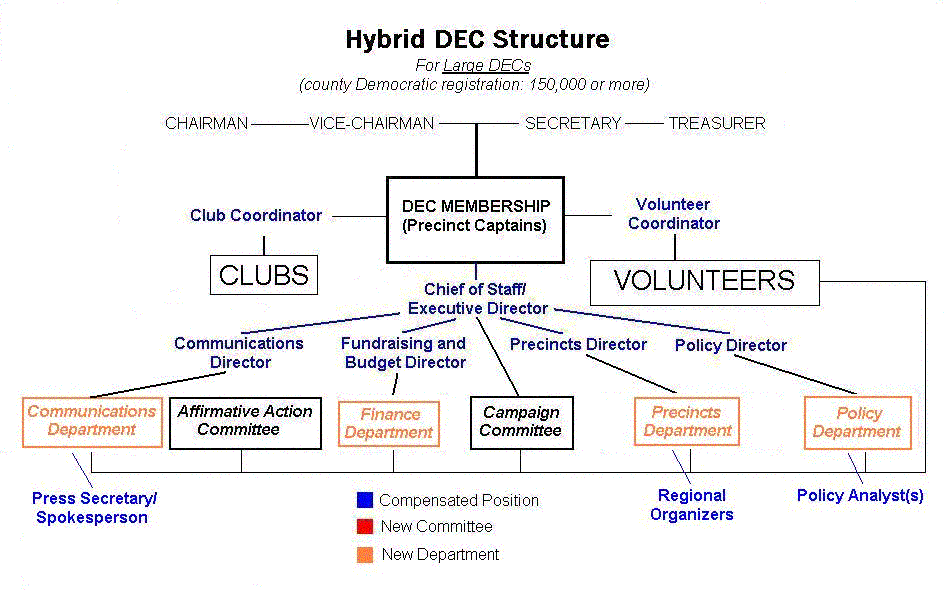 Click the image for a bigger picture.
As you can see, individual staffers are now put in charge of entire departments in large DECs. This is because as DECs grow and expand, and the need for more than one paid staffer to handle specific operations such as communications, fundraising, etc..., grows exponentially. You'll also see the addition of specific paid positions within departments.
Departments (Communications, Finance, Precincts, and Policy): As mentioned previously, departments are used to organize all paid staffers who deal with responsibilities normally given to one specific staffer in medium and small DECs. The directors (communications, finance & budget, precincts, and policy) are the heads of their respective departments and are responsible for coordinating their respective staffers to accomplish objectives.
Press Secretary/Spokesperson: Under the purview of the Communications Director and a staffer within the Communication's Department, the press secretary or spokesperson for the DEC is responsible for being the public face of the DEC next to the chair. They are also responsible for being a liaison with the press. Their main job however is to control the message and overall perception of the DEC to the public.
Regional Organizers: Under the purview of the Precincts Director and are staffers within the Precincts Deparment, regional organizers are assigned regions within the county (preferably pertaining to county commission district lines) to organize and maintain the precinct structure there. They might be responsible for managing county party satellite offices if the DEC decides to have them. They are responsible for reporting back to the Precincts Director about precinct level issues and progress. In turn the Precincts Director should work very closley to make sure decisions made by the chair, the chief of staff/executive director, or the DEC itself are actually implemented. Regional organizers take a lot of pressure and workload off of the Precinct Director, who can concentrate more on overall grassroots strategy and tactics, rather than having to call a couple hundred precinct captains in order to get something done.
Policy Analysts: Under the purview of the Policy Director and are staffers within the Policy Department, policy analysts are responsible for assisting the policy director in the research of critical policy questions and the development of understandable reports to the DEC and the public. Policy analysts could be assigned important research fields based on previous expertise (education, health care, growth management, urban planning, etc...)
* * *
This concludes my posts (for now anyway) on structural models for DECs. I hope to do some posts in the future on new roles I believe DECs should step into, and possibly some more posts on fundraising, and maybe some on policy.
Tuesday, February 14, 2006
A Better Organizational Structure for DECs
As mentioned in the previous post on what the average current DEC organization looks like, the current form of organization is ineffective, perpetuates a cycle of failure, puts too much responsibility on the shoulders of inexperienced volunteers, and just doesn't get the job done.
So what does an ideal DEC look like. What kind of committees does it have? What kind of staff needs to be hired? What is the relationship between elected officers, paid staff, committees, and volunteers? How does it all flow? In this post, I will present three models for possible DEC organization. Keep in mind that DECs should always be constantly evolving, and should probably not EXACTLY look like one of the models. They are mere points of references for how DECs should grow, or downsize. I present three different models (for small, medium, and large-sized DECs) because DECs throughout Florida are very diverse, from the very small DECs in the small panhandle and North Florida counties, to the massive DECs of Miami-Dade, Broward, and Palm Beach Counties, and all the others inbetween. Each model is what I call a hybrid model which is a healthy cross between an all paid staff organization and an all volunteer based organization.
Refer back to my illustration of today's Common DEC Structure to visually see the differences in structure.
Small DECs (to 50,000 registered Democrats in the county)
The vast majority of small DECs are located in North Florida, where a lot of folks (though not all) don't exactly have deep pockets and work blue collar jobs for low pay. Dixiecrats (Democrats with conservative convictions who most often vote Republican) are the most numerous here. The number of loyal Democrats is often smaller than the raw registration number of the county, thus limiting DECs (where they exist, keep in mind many DECs in North Florida are MIA) resources and operational capabilities. Here's the ideal structure:
 As you will see in the rest of the models, the elected officers are retained. They are important because this allows the DEC membership (the precinct captains) to retain complete control over the organization, and that the overall idea of the DEC as a Democratic institution isn't undermined. I say this because there is a concern by some that by transitioning the DEC from an all volunteer organization to one that is increasingly reliant on the work of paid staffers, will undermine the DECs role as an important Democratic institution. This is the main way I keep checks and balances involved in the process.
In this model, there are three paid staffers: a communications director, a finance and budget director, and a precincts director. You'll notice that each staffer "co-chairs" a committee with a volunteer chair. Here's what each staffer is responsible for:
Communications Director: The communications director is responsible for devising and carrying out public relations strategies. This involves the creation of an overall message and theme derived from a combination of forces (the Policy Committee, elected officials, word from the grassroots through the precinct captains, etc...) It then involves the distribution of press releases, planning and execution of press events, and the creation of talking points which can be quickly distributed to the party infrastructure throughout the county and to the state party if necessary. They co-chair the Events Committee.
Fundraising and Budget Director: The "F&B Director" is responsible for creating and maintaining a multitude of party fundraising campaigns, thus constantly raising money and finding new ways to raise it. They are also responsible for maintaining a state of fiscal responsibility within the party's budget. They draw up the budget, allocating funds to each committee and program. The budget should be approved by the DEC at large at a time worked about between the F&B Director and the party chair (should a budget be approved annually, quarterly, monthly?) They also work with the party chair and the chief of staff/executive director (seen in the next model) to determine staffers' salary. They co-chair the Fundraising Committee.
Precincts Director: The Precincts Director is responsible for recruiting, maintaining, and moving the arms of the party's vital precinct captain infrastructure. They work back and forth between the party's staff and precinct captains and make sure operational decisions made at the top, find their way to the party's grassroots and are actually enacted. They co-chair the Membership/Precincts Committee.
Also in this model there is one new committee, the Policy Committee
Policy Committee: Even though this is sometimes mandated by DEC bylaws, not all DECs have them. I will discuss the overall need for county parties across the nation to establish strong policy creation and analytical arms to create the fuel needed for candidates to round out their campaigns, give the local party focus, and give precinct captains, volunteers, and community activists something to shoot for. This committees focus is to do research on public policy issues and find solutions to public policy problems. They should publish regular reports on a wide variety of public policy issues. The committee should be a hybrid of community experts in various fields and volunteers and citizens with a desire to learn more and be active on a public policy issue or issues.
Medium DECs (50,000- 150,000 registered Democrats in the county)
 Chief of Staff/Executive Director: The Chief of Staff or the Executive Director (whichever you and your DEC prefers) is in charge of running the day-to-day party operations. The instant question is, "What about the chair, aren't they responsible for this?" Of course. As DECs evolve and grow, the chair is pulled in more and more directions. The chair has oversight over everything the Chief of Staff does, and actually should appoint the Chief of Staff and then the Chief of Staff should be approved by a majority vote in the DEC. The Chief of Staff is responsible for advising the chair in the hiring and firing process (the chair must approve all hirings and firings, as well as be approved by the DEC.) The Chief of Staff is additionally responsible for holding regular staff meetings (preferably daily) and coordinate the party's activities through the various staffers that work for the party. Plain and simple, they make sure things get done, and that the chair and thus the DEC is constanly informed. They co-chair the Camapaign Committee.
Policy Director: The Policy Director is responsible for coordinating, drawing conclusions, and tying together various policy ideas put forward at all levels, from national think tanks, to scholarly and news articles, and to the ideas and proposals of the policy committee into clear policy positions for the local party to adopt. They co-chair the Policy Committee.
Club Coordinator: The Club Coordinator is responsible for working with the multitude of Democratic clubs throughout the county, making sure they're registered and in compliance with state party bylaws and state government regulations. They are also responsible for making sure clubs are informed of what the DEC is doing, and that clubs are involved in the process. The Club Coordinator is also constantly looking to start new clubs as well as maitain and offer organizational assistance to existing clubs.
Volunteer Coordinator: The Volunteer Coordinator is responsible for recruiting, maintaining an accurate list of, coordinating, and rewarding active volunteers. For all the operations the party and individual campaigns conduct, the volunteer coordinator should work with the appropriate staffer/committee/elected official to make sure the operation/event is properly staffed by volunteers. They should work heavily with the Precinct Director and the precinct captains.
...OK folks, I'm a little tired from typing all this. I'll start back tommorrow and finish up this post by discussing the ideal structure for large DECs (150,000 registered Democrats in the county or more.)
So what does an ideal DEC look like. What kind of committees does it have? What kind of staff needs to be hired? What is the relationship between elected officers, paid staff, committees, and volunteers? How does it all flow? In this post, I will present three models for possible DEC organization. Keep in mind that DECs should always be constantly evolving, and should probably not EXACTLY look like one of the models. They are mere points of references for how DECs should grow, or downsize. I present three different models (for small, medium, and large-sized DECs) because DECs throughout Florida are very diverse, from the very small DECs in the small panhandle and North Florida counties, to the massive DECs of Miami-Dade, Broward, and Palm Beach Counties, and all the others inbetween. Each model is what I call a hybrid model which is a healthy cross between an all paid staff organization and an all volunteer based organization.
Refer back to my illustration of today's Common DEC Structure to visually see the differences in structure.
Small DECs (to 50,000 registered Democrats in the county)
The vast majority of small DECs are located in North Florida, where a lot of folks (though not all) don't exactly have deep pockets and work blue collar jobs for low pay. Dixiecrats (Democrats with conservative convictions who most often vote Republican) are the most numerous here. The number of loyal Democrats is often smaller than the raw registration number of the county, thus limiting DECs (where they exist, keep in mind many DECs in North Florida are MIA) resources and operational capabilities. Here's the ideal structure:
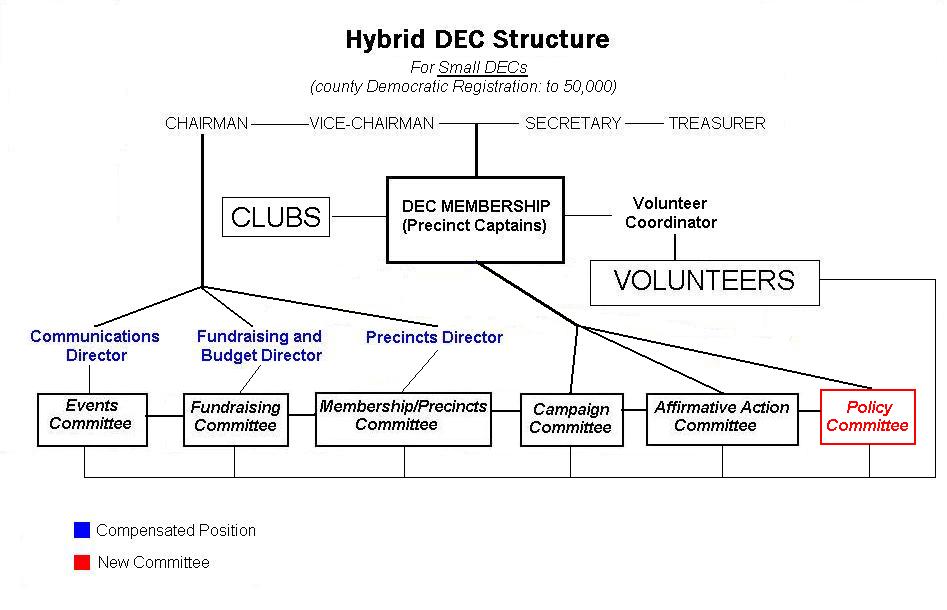 As you will see in the rest of the models, the elected officers are retained. They are important because this allows the DEC membership (the precinct captains) to retain complete control over the organization, and that the overall idea of the DEC as a Democratic institution isn't undermined. I say this because there is a concern by some that by transitioning the DEC from an all volunteer organization to one that is increasingly reliant on the work of paid staffers, will undermine the DECs role as an important Democratic institution. This is the main way I keep checks and balances involved in the process.
In this model, there are three paid staffers: a communications director, a finance and budget director, and a precincts director. You'll notice that each staffer "co-chairs" a committee with a volunteer chair. Here's what each staffer is responsible for:
Communications Director: The communications director is responsible for devising and carrying out public relations strategies. This involves the creation of an overall message and theme derived from a combination of forces (the Policy Committee, elected officials, word from the grassroots through the precinct captains, etc...) It then involves the distribution of press releases, planning and execution of press events, and the creation of talking points which can be quickly distributed to the party infrastructure throughout the county and to the state party if necessary. They co-chair the Events Committee.
Fundraising and Budget Director: The "F&B Director" is responsible for creating and maintaining a multitude of party fundraising campaigns, thus constantly raising money and finding new ways to raise it. They are also responsible for maintaining a state of fiscal responsibility within the party's budget. They draw up the budget, allocating funds to each committee and program. The budget should be approved by the DEC at large at a time worked about between the F&B Director and the party chair (should a budget be approved annually, quarterly, monthly?) They also work with the party chair and the chief of staff/executive director (seen in the next model) to determine staffers' salary. They co-chair the Fundraising Committee.
Precincts Director: The Precincts Director is responsible for recruiting, maintaining, and moving the arms of the party's vital precinct captain infrastructure. They work back and forth between the party's staff and precinct captains and make sure operational decisions made at the top, find their way to the party's grassroots and are actually enacted. They co-chair the Membership/Precincts Committee.
Also in this model there is one new committee, the Policy Committee
Policy Committee: Even though this is sometimes mandated by DEC bylaws, not all DECs have them. I will discuss the overall need for county parties across the nation to establish strong policy creation and analytical arms to create the fuel needed for candidates to round out their campaigns, give the local party focus, and give precinct captains, volunteers, and community activists something to shoot for. This committees focus is to do research on public policy issues and find solutions to public policy problems. They should publish regular reports on a wide variety of public policy issues. The committee should be a hybrid of community experts in various fields and volunteers and citizens with a desire to learn more and be active on a public policy issue or issues.
Medium DECs (50,000- 150,000 registered Democrats in the county)
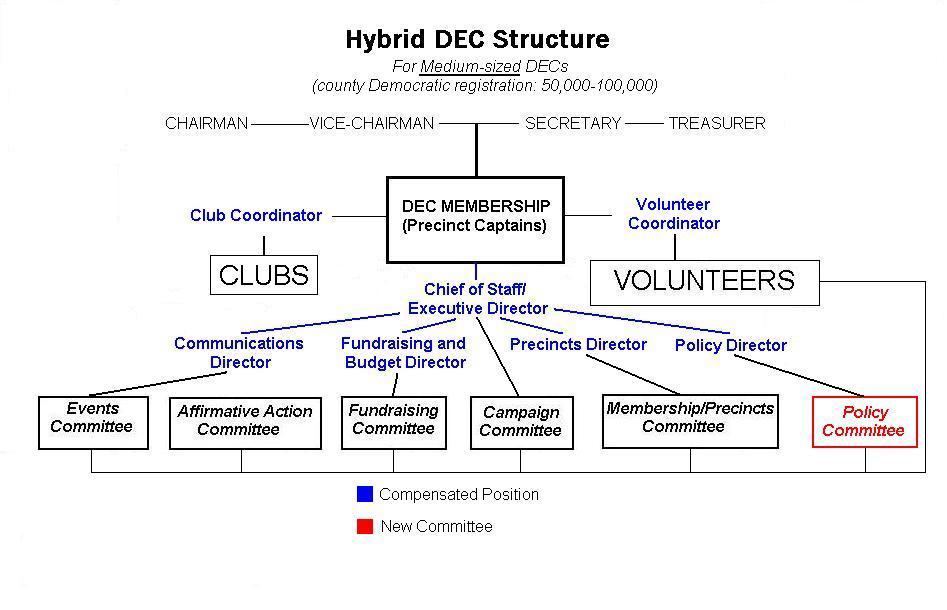 Chief of Staff/Executive Director: The Chief of Staff or the Executive Director (whichever you and your DEC prefers) is in charge of running the day-to-day party operations. The instant question is, "What about the chair, aren't they responsible for this?" Of course. As DECs evolve and grow, the chair is pulled in more and more directions. The chair has oversight over everything the Chief of Staff does, and actually should appoint the Chief of Staff and then the Chief of Staff should be approved by a majority vote in the DEC. The Chief of Staff is responsible for advising the chair in the hiring and firing process (the chair must approve all hirings and firings, as well as be approved by the DEC.) The Chief of Staff is additionally responsible for holding regular staff meetings (preferably daily) and coordinate the party's activities through the various staffers that work for the party. Plain and simple, they make sure things get done, and that the chair and thus the DEC is constanly informed. They co-chair the Camapaign Committee.
Policy Director: The Policy Director is responsible for coordinating, drawing conclusions, and tying together various policy ideas put forward at all levels, from national think tanks, to scholarly and news articles, and to the ideas and proposals of the policy committee into clear policy positions for the local party to adopt. They co-chair the Policy Committee.
Club Coordinator: The Club Coordinator is responsible for working with the multitude of Democratic clubs throughout the county, making sure they're registered and in compliance with state party bylaws and state government regulations. They are also responsible for making sure clubs are informed of what the DEC is doing, and that clubs are involved in the process. The Club Coordinator is also constantly looking to start new clubs as well as maitain and offer organizational assistance to existing clubs.
Volunteer Coordinator: The Volunteer Coordinator is responsible for recruiting, maintaining an accurate list of, coordinating, and rewarding active volunteers. For all the operations the party and individual campaigns conduct, the volunteer coordinator should work with the appropriate staffer/committee/elected official to make sure the operation/event is properly staffed by volunteers. They should work heavily with the Precinct Director and the precinct captains.
...OK folks, I'm a little tired from typing all this. I'll start back tommorrow and finish up this post by discussing the ideal structure for large DECs (150,000 registered Democrats in the county or more.)
Subscribe to:
Posts (Atom)