
DECs have been increasingly focused on camapaigns, candidates, and election cycles. This is OK, because it is their main purpose (currently) to get Democrats elected. But looking in in the long term, and increasingly in the short term as Democrats keep losing, DECs should realize that campaigns aren't the all to end all. What really propels campaings? What provoks long term realignment ( what should be the real goal of any DEC and the Democratic Party)? What can take a weak, losing minority party and turn it into a political powerhouse? One word: ideas.
The source of the Democratic Party's slow erosion at the national level since the late 1970s onward began in neighborhoods and communities across America. Republicans were able to get elected at the local level, which in turn provided a farm team for state, and then national office, as well as fodder for think tanks, the right's media machine, and its overall political party infrastructure nationwide.
The route for the Democrats back to power is through local office. But we cannot just expect to get the increasingly dissolusioned base out to vote, as well as persuade independents to cross over by going about politics as usual, or even by railing at Republican ineptitude. We need our own ideas. Democrats and progressives are not devoid of ideas, as many right-wing talking heads will have you believe. There is a multitude of ideas out there, our problem is putting them all together in cohesive platforms and agendas, and then weaving them together with effective public relations strategies.
As I said in previous posts on DEC model structures, DECs should form their own Policy Committies, and later when resources become available, hire a Policy Director to manage it. Local problems should be worked out by these committees and hired staff which should form a county platform. The platform, for each plank, should include background information on the issue, possible (or lack of) attempts in the past to solve the issue, and a series of proposals to solve the problem. There should be talking points for each plank to be distributed to precinct captains and communications staffers/volunteers. Many are critical of forming platforms, as "no one reads them." Indeed, if county or state platforms are introduced to the public in the form of one press release (if at all), then yes, no one will read them or care. However, if these platforms give some substantial and credible proposals (unlike many state platforms, which are mostly a bunch of fancy, useless wording), and is backed up a vigorous PR campaign which includes articulation of proposals by candidates, party officials, precinct captains, and on the ground volunteers, people will listen and respond with their votes.
DECs should not wait for the state or national party to hand down the overall message, because in all honesty, the DNC is in charge of national message, and the FDP is in charge of state message. There are many important local issues that just simply will never be addressed by the state party, because they don't need to.
At the end of hte day, its up to the DECs to become local policymakers and innovators and provide candidates and citizens with the tools needed to improve their communities.
I've started up a blog, Florida Public Policy, to give progressives at all levels proper background information and possible solutions to local and state issues. I encourage all progressives to check it out!
Saturday, February 25, 2006


Friday, February 24, 2006
Introducing Florida Public Policy Blog
Hey everyone. I'm announcing the creation of a new blog that will deal with Florida public policy - from a progressive point of view.
The motto of Florida Public Policy is to analyze Republican public policy missteps and propose new solutions for Democrats to use at the local and state level in the state of Florida and possibly throughout the United States.
The motto of Florida Public Policy is to analyze Republican public policy missteps and propose new solutions for Democrats to use at the local and state level in the state of Florida and possibly throughout the United States.
We Democrats and progressives are not devoid of ideas. We just lack the communication and cohesion needed to coalesce and distribute the billions of ideas coming from progressive think tanks, legislators, and citizen activists. I hope Florida Public Policy will become a clearinghouse for new ideas to solve Florida's many issues.
Ideas have in the past, and will in the future, propel the Democratic Party to the helm of the United States.
I encourage all of you here at FLA Politics to be on the lookout for new reports and ideas that pertain to Florida or the many issues affecting Florida, and report them on this blog as well as Florida Public Policy.
Here's the link:
http://floridapublicpolicy.blogspot.com/
I already have posted a new idea on how to better manage our growth - through higher density development versus low density development via a new report from the EPA. Check it out!
* Regular readers of this blog: This will dovetail with a new theme I will role out for Florida DECs in the coming days.
Thursday, February 23, 2006
A Better Organizational Structure for DECs (cont...)
This is a continuation of my last post on better DEC structures. This post will discuss how best to attempt to organize large DECs. At this point, I would also like to clear the air about some things that have been mentioned about my proposals for restructuring DECs. The models I present should not be considered absolutely concrete and binding. DECs should always be fluctating between the various models I present. These models are merely guideposts as DECs grow or downsize.
Large Sized DECs (150,000 or more Democrats registered in the county)
 Click the image for a bigger picture.
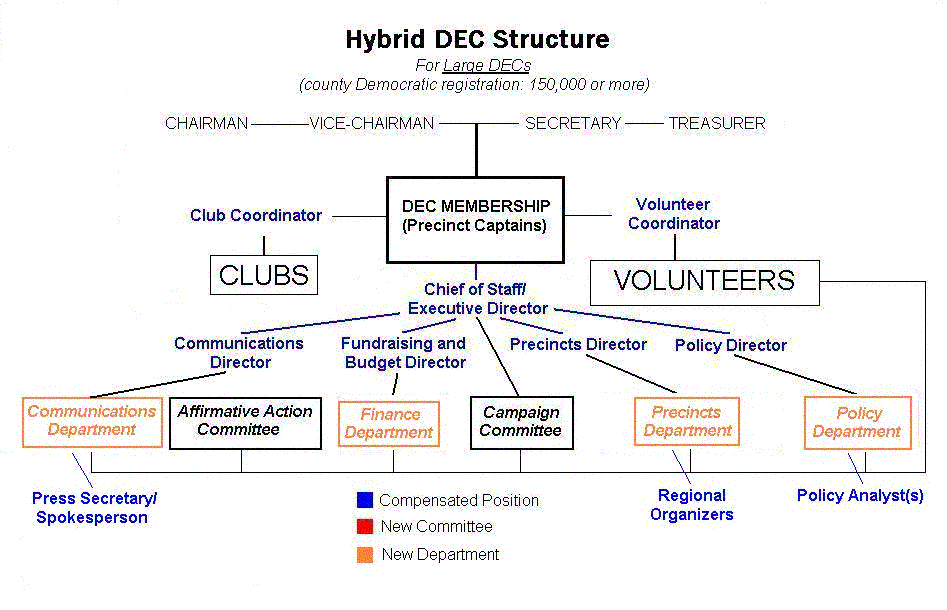
As you can see, individual staffers are now put in charge of entire departments in large DECs. This is because as DECs grow and expand, and the need for more than one paid staffer to handle specific operations such as communications, fundraising, etc..., grows exponentially. You'll also see the addition of specific paid positions within departments.
Departments (Communications, Finance, Precincts, and Policy): As mentioned previously, departments are used to organize all paid staffers who deal with responsibilities normally given to one specific staffer in medium and small DECs. The directors (communications, finance & budget, precincts, and policy) are the heads of their respective departments and are responsible for coordinating their respective staffers to accomplish objectives.
Press Secretary/Spokesperson: Under the purview of the Communications Director and a staffer within the Communication's Department, the press secretary or spokesperson for the DEC is responsible for being the public face of the DEC next to the chair. They are also responsible for being a liaison with the press. Their main job however is to control the message and overall perception of the DEC to the public.
Regional Organizers: Under the purview of the Precincts Director and are staffers within the Precincts Deparment, regional organizers are assigned regions within the county (preferably pertaining to county commission district lines) to organize and maintain the precinct structure there. They might be responsible for managing county party satellite offices if the DEC decides to have them. They are responsible for reporting back to the Precincts Director about precinct level issues and progress. In turn the Precincts Director should work very closley to make sure decisions made by the chair, the chief of staff/executive director, or the DEC itself are actually implemented. Regional organizers take a lot of pressure and workload off of the Precinct Director, who can concentrate more on overall grassroots strategy and tactics, rather than having to call a couple hundred precinct captains in order to get something done.
Policy Analysts: Under the purview of the Policy Director and are staffers within the Policy Department, policy analysts are responsible for assisting the policy director in the research of critical policy questions and the development of understandable reports to the DEC and the public. Policy analysts could be assigned important research fields based on previous expertise (education, health care, growth management, urban planning, etc...)
This concludes my posts (for now anyway) on structural models for DECs. I hope to do some posts in the future on new roles I believe DECs should step into, and possibly some more posts on fundraising, and maybe some on policy.
Large Sized DECs (150,000 or more Democrats registered in the county)
 Click the image for a bigger picture.
As you can see, individual staffers are now put in charge of entire departments in large DECs. This is because as DECs grow and expand, and the need for more than one paid staffer to handle specific operations such as communications, fundraising, etc..., grows exponentially. You'll also see the addition of specific paid positions within departments.
Departments (Communications, Finance, Precincts, and Policy): As mentioned previously, departments are used to organize all paid staffers who deal with responsibilities normally given to one specific staffer in medium and small DECs. The directors (communications, finance & budget, precincts, and policy) are the heads of their respective departments and are responsible for coordinating their respective staffers to accomplish objectives.
Press Secretary/Spokesperson: Under the purview of the Communications Director and a staffer within the Communication's Department, the press secretary or spokesperson for the DEC is responsible for being the public face of the DEC next to the chair. They are also responsible for being a liaison with the press. Their main job however is to control the message and overall perception of the DEC to the public.
Regional Organizers: Under the purview of the Precincts Director and are staffers within the Precincts Deparment, regional organizers are assigned regions within the county (preferably pertaining to county commission district lines) to organize and maintain the precinct structure there. They might be responsible for managing county party satellite offices if the DEC decides to have them. They are responsible for reporting back to the Precincts Director about precinct level issues and progress. In turn the Precincts Director should work very closley to make sure decisions made by the chair, the chief of staff/executive director, or the DEC itself are actually implemented. Regional organizers take a lot of pressure and workload off of the Precinct Director, who can concentrate more on overall grassroots strategy and tactics, rather than having to call a couple hundred precinct captains in order to get something done.
Policy Analysts: Under the purview of the Policy Director and are staffers within the Policy Department, policy analysts are responsible for assisting the policy director in the research of critical policy questions and the development of understandable reports to the DEC and the public. Policy analysts could be assigned important research fields based on previous expertise (education, health care, growth management, urban planning, etc...)
* * *
This concludes my posts (for now anyway) on structural models for DECs. I hope to do some posts in the future on new roles I believe DECs should step into, and possibly some more posts on fundraising, and maybe some on policy.
Tuesday, February 14, 2006
A Better Organizational Structure for DECs
As mentioned in the previous post on what the average current DEC organization looks like, the current form of organization is ineffective, perpetuates a cycle of failure, puts too much responsibility on the shoulders of inexperienced volunteers, and just doesn't get the job done.
So what does an ideal DEC look like. What kind of committees does it have? What kind of staff needs to be hired? What is the relationship between elected officers, paid staff, committees, and volunteers? How does it all flow? In this post, I will present three models for possible DEC organization. Keep in mind that DECs should always be constantly evolving, and should probably not EXACTLY look like one of the models. They are mere points of references for how DECs should grow, or downsize. I present three different models (for small, medium, and large-sized DECs) because DECs throughout Florida are very diverse, from the very small DECs in the small panhandle and North Florida counties, to the massive DECs of Miami-Dade, Broward, and Palm Beach Counties, and all the others inbetween. Each model is what I call a hybrid model which is a healthy cross between an all paid staff organization and an all volunteer based organization.
Refer back to my illustration of today's Common DEC Structure to visually see the differences in structure.
Small DECs (to 50,000 registered Democrats in the county)
The vast majority of small DECs are located in North Florida, where a lot of folks (though not all) don't exactly have deep pockets and work blue collar jobs for low pay. Dixiecrats (Democrats with conservative convictions who most often vote Republican) are the most numerous here. The number of loyal Democrats is often smaller than the raw registration number of the county, thus limiting DECs (where they exist, keep in mind many DECs in North Florida are MIA) resources and operational capabilities. Here's the ideal structure:
 As you will see in the rest of the models, the elected officers are retained. They are important because this allows the DEC membership (the precinct captains) to retain complete control over the organization, and that the overall idea of the DEC as a Democratic institution isn't undermined. I say this because there is a concern by some that by transitioning the DEC from an all volunteer organization to one that is increasingly reliant on the work of paid staffers, will undermine the DECs role as an important Democratic institution. This is the main way I keep checks and balances involved in the process.
In this model, there are three paid staffers: a communications director, a finance and budget director, and a precincts director. You'll notice that each staffer "co-chairs" a committee with a volunteer chair. Here's what each staffer is responsible for:
Communications Director: The communications director is responsible for devising and carrying out public relations strategies. This involves the creation of an overall message and theme derived from a combination of forces (the Policy Committee, elected officials, word from the grassroots through the precinct captains, etc...) It then involves the distribution of press releases, planning and execution of press events, and the creation of talking points which can be quickly distributed to the party infrastructure throughout the county and to the state party if necessary. They co-chair the Events Committee.
Fundraising and Budget Director: The "F&B Director" is responsible for creating and maintaining a multitude of party fundraising campaigns, thus constantly raising money and finding new ways to raise it. They are also responsible for maintaining a state of fiscal responsibility within the party's budget. They draw up the budget, allocating funds to each committee and program. The budget should be approved by the DEC at large at a time worked about between the F&B Director and the party chair (should a budget be approved annually, quarterly, monthly?) They also work with the party chair and the chief of staff/executive director (seen in the next model) to determine staffers' salary. They co-chair the Fundraising Committee.
Precincts Director: The Precincts Director is responsible for recruiting, maintaining, and moving the arms of the party's vital precinct captain infrastructure. They work back and forth between the party's staff and precinct captains and make sure operational decisions made at the top, find their way to the party's grassroots and are actually enacted. They co-chair the Membership/Precincts Committee.
Also in this model there is one new committee, the Policy Committee
Policy Committee: Even though this is sometimes mandated by DEC bylaws, not all DECs have them. I will discuss the overall need for county parties across the nation to establish strong policy creation and analytical arms to create the fuel needed for candidates to round out their campaigns, give the local party focus, and give precinct captains, volunteers, and community activists something to shoot for. This committees focus is to do research on public policy issues and find solutions to public policy problems. They should publish regular reports on a wide variety of public policy issues. The committee should be a hybrid of community experts in various fields and volunteers and citizens with a desire to learn more and be active on a public policy issue or issues.
Medium DECs (50,000- 150,000 registered Democrats in the county)
 Chief of Staff/Executive Director: The Chief of Staff or the Executive Director (whichever you and your DEC prefers) is in charge of running the day-to-day party operations. The instant question is, "What about the chair, aren't they responsible for this?" Of course. As DECs evolve and grow, the chair is pulled in more and more directions. The chair has oversight over everything the Chief of Staff does, and actually should appoint the Chief of Staff and then the Chief of Staff should be approved by a majority vote in the DEC. The Chief of Staff is responsible for advising the chair in the hiring and firing process (the chair must approve all hirings and firings, as well as be approved by the DEC.) The Chief of Staff is additionally responsible for holding regular staff meetings (preferably daily) and coordinate the party's activities through the various staffers that work for the party. Plain and simple, they make sure things get done, and that the chair and thus the DEC is constanly informed. They co-chair the Camapaign Committee.
Policy Director: The Policy Director is responsible for coordinating, drawing conclusions, and tying together various policy ideas put forward at all levels, from national think tanks, to scholarly and news articles, and to the ideas and proposals of the policy committee into clear policy positions for the local party to adopt. They co-chair the Policy Committee.
Club Coordinator: The Club Coordinator is responsible for working with the multitude of Democratic clubs throughout the county, making sure they're registered and in compliance with state party bylaws and state government regulations. They are also responsible for making sure clubs are informed of what the DEC is doing, and that clubs are involved in the process. The Club Coordinator is also constantly looking to start new clubs as well as maitain and offer organizational assistance to existing clubs.
Volunteer Coordinator: The Volunteer Coordinator is responsible for recruiting, maintaining an accurate list of, coordinating, and rewarding active volunteers. For all the operations the party and individual campaigns conduct, the volunteer coordinator should work with the appropriate staffer/committee/elected official to make sure the operation/event is properly staffed by volunteers. They should work heavily with the Precinct Director and the precinct captains.
...OK folks, I'm a little tired from typing all this. I'll start back tommorrow and finish up this post by discussing the ideal structure for large DECs (150,000 registered Democrats in the county or more.)
So what does an ideal DEC look like. What kind of committees does it have? What kind of staff needs to be hired? What is the relationship between elected officers, paid staff, committees, and volunteers? How does it all flow? In this post, I will present three models for possible DEC organization. Keep in mind that DECs should always be constantly evolving, and should probably not EXACTLY look like one of the models. They are mere points of references for how DECs should grow, or downsize. I present three different models (for small, medium, and large-sized DECs) because DECs throughout Florida are very diverse, from the very small DECs in the small panhandle and North Florida counties, to the massive DECs of Miami-Dade, Broward, and Palm Beach Counties, and all the others inbetween. Each model is what I call a hybrid model which is a healthy cross between an all paid staff organization and an all volunteer based organization.
Refer back to my illustration of today's Common DEC Structure to visually see the differences in structure.
Small DECs (to 50,000 registered Democrats in the county)
The vast majority of small DECs are located in North Florida, where a lot of folks (though not all) don't exactly have deep pockets and work blue collar jobs for low pay. Dixiecrats (Democrats with conservative convictions who most often vote Republican) are the most numerous here. The number of loyal Democrats is often smaller than the raw registration number of the county, thus limiting DECs (where they exist, keep in mind many DECs in North Florida are MIA) resources and operational capabilities. Here's the ideal structure:
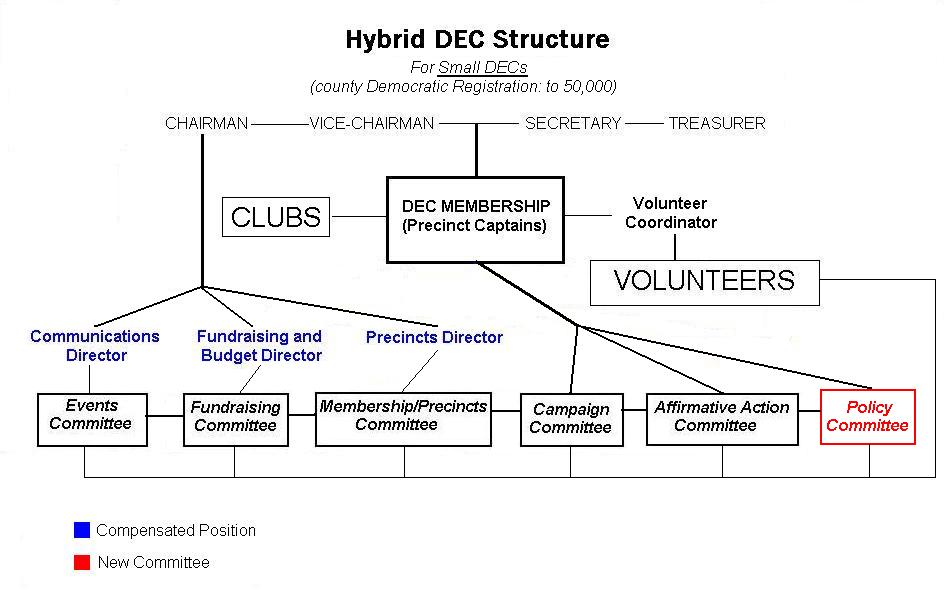 As you will see in the rest of the models, the elected officers are retained. They are important because this allows the DEC membership (the precinct captains) to retain complete control over the organization, and that the overall idea of the DEC as a Democratic institution isn't undermined. I say this because there is a concern by some that by transitioning the DEC from an all volunteer organization to one that is increasingly reliant on the work of paid staffers, will undermine the DECs role as an important Democratic institution. This is the main way I keep checks and balances involved in the process.
In this model, there are three paid staffers: a communications director, a finance and budget director, and a precincts director. You'll notice that each staffer "co-chairs" a committee with a volunteer chair. Here's what each staffer is responsible for:
Communications Director: The communications director is responsible for devising and carrying out public relations strategies. This involves the creation of an overall message and theme derived from a combination of forces (the Policy Committee, elected officials, word from the grassroots through the precinct captains, etc...) It then involves the distribution of press releases, planning and execution of press events, and the creation of talking points which can be quickly distributed to the party infrastructure throughout the county and to the state party if necessary. They co-chair the Events Committee.
Fundraising and Budget Director: The "F&B Director" is responsible for creating and maintaining a multitude of party fundraising campaigns, thus constantly raising money and finding new ways to raise it. They are also responsible for maintaining a state of fiscal responsibility within the party's budget. They draw up the budget, allocating funds to each committee and program. The budget should be approved by the DEC at large at a time worked about between the F&B Director and the party chair (should a budget be approved annually, quarterly, monthly?) They also work with the party chair and the chief of staff/executive director (seen in the next model) to determine staffers' salary. They co-chair the Fundraising Committee.
Precincts Director: The Precincts Director is responsible for recruiting, maintaining, and moving the arms of the party's vital precinct captain infrastructure. They work back and forth between the party's staff and precinct captains and make sure operational decisions made at the top, find their way to the party's grassroots and are actually enacted. They co-chair the Membership/Precincts Committee.
Also in this model there is one new committee, the Policy Committee
Policy Committee: Even though this is sometimes mandated by DEC bylaws, not all DECs have them. I will discuss the overall need for county parties across the nation to establish strong policy creation and analytical arms to create the fuel needed for candidates to round out their campaigns, give the local party focus, and give precinct captains, volunteers, and community activists something to shoot for. This committees focus is to do research on public policy issues and find solutions to public policy problems. They should publish regular reports on a wide variety of public policy issues. The committee should be a hybrid of community experts in various fields and volunteers and citizens with a desire to learn more and be active on a public policy issue or issues.
Medium DECs (50,000- 150,000 registered Democrats in the county)
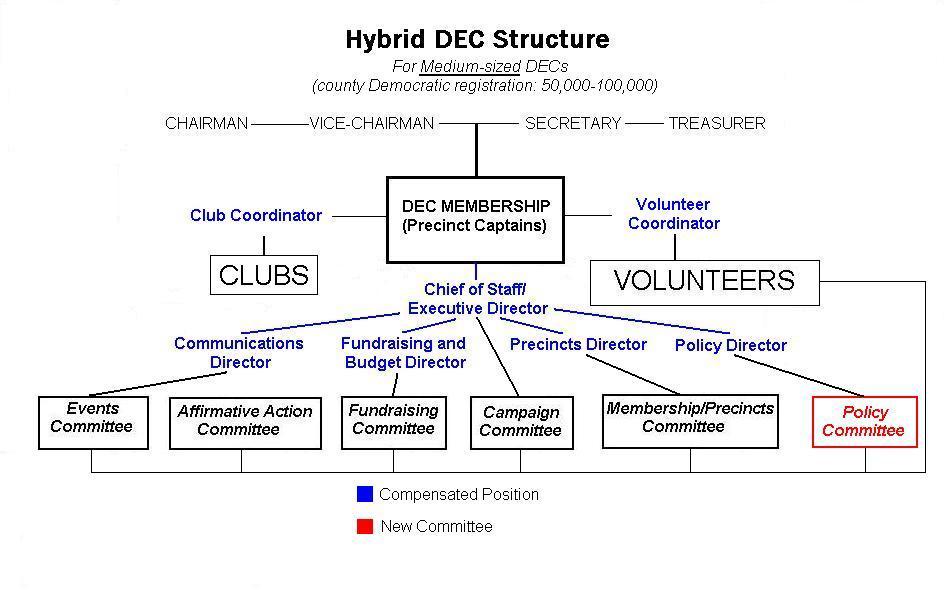 Chief of Staff/Executive Director: The Chief of Staff or the Executive Director (whichever you and your DEC prefers) is in charge of running the day-to-day party operations. The instant question is, "What about the chair, aren't they responsible for this?" Of course. As DECs evolve and grow, the chair is pulled in more and more directions. The chair has oversight over everything the Chief of Staff does, and actually should appoint the Chief of Staff and then the Chief of Staff should be approved by a majority vote in the DEC. The Chief of Staff is responsible for advising the chair in the hiring and firing process (the chair must approve all hirings and firings, as well as be approved by the DEC.) The Chief of Staff is additionally responsible for holding regular staff meetings (preferably daily) and coordinate the party's activities through the various staffers that work for the party. Plain and simple, they make sure things get done, and that the chair and thus the DEC is constanly informed. They co-chair the Camapaign Committee.
Policy Director: The Policy Director is responsible for coordinating, drawing conclusions, and tying together various policy ideas put forward at all levels, from national think tanks, to scholarly and news articles, and to the ideas and proposals of the policy committee into clear policy positions for the local party to adopt. They co-chair the Policy Committee.
Club Coordinator: The Club Coordinator is responsible for working with the multitude of Democratic clubs throughout the county, making sure they're registered and in compliance with state party bylaws and state government regulations. They are also responsible for making sure clubs are informed of what the DEC is doing, and that clubs are involved in the process. The Club Coordinator is also constantly looking to start new clubs as well as maitain and offer organizational assistance to existing clubs.
Volunteer Coordinator: The Volunteer Coordinator is responsible for recruiting, maintaining an accurate list of, coordinating, and rewarding active volunteers. For all the operations the party and individual campaigns conduct, the volunteer coordinator should work with the appropriate staffer/committee/elected official to make sure the operation/event is properly staffed by volunteers. They should work heavily with the Precinct Director and the precinct captains.
...OK folks, I'm a little tired from typing all this. I'll start back tommorrow and finish up this post by discussing the ideal structure for large DECs (150,000 registered Democrats in the county or more.)
Saturday, February 11, 2006
Today's DEC Structure
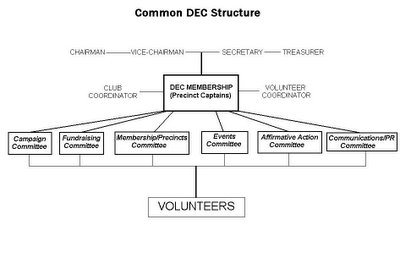
This is how most DECs are GENERALLY organized:
 Click on the image for a larger view.
As you can see, today's DECs are completely dependent on volunteers and committees. Each of its major responsbilities has a committee dealing with the issue.
In an ideal world, all of this would flow nicely, each committee would have a group of 7-15 members who would world cohesivley to come up with specific solutions and prescriptions to the issues affecting their area of focus. Also, each committee would work with each other and arrange their agendas, operations, and plans accordingly. Designated committee members would make regular reports to the Executive Board (the top 4 elected positions) or a Steering Committee (not mentioned in this DEC model, but is used in some DECs.) The Executive Board or Steering Committee would coordinate and organize all of these committees around a few (3-5) main objectives and guide them in the same direction.
Unfortunately, this isn't an ideal world. As mentioned in my previous post, volunteers aren't terribly reliable, many lack proper training, background, or experience in the necessary fields (communications, events coordination, campaign/project management, fundraising, etc...) and have their own narrow agendas and priorities. These committees usually meet irregularly, if at all in some DECs, and even those that meet regularly usually only meet once a month. This, of course, is not enough to adequately plan and enact operations needed to unseat an entrenched Republican majority, or keeping elected Democrats well supported and reinforced.
We need large structural reforms in DECs if we are to be successful in 2006 and beyond. My next post will be on the ideal DEC structure at different levels (in small, medium, and large counties.)
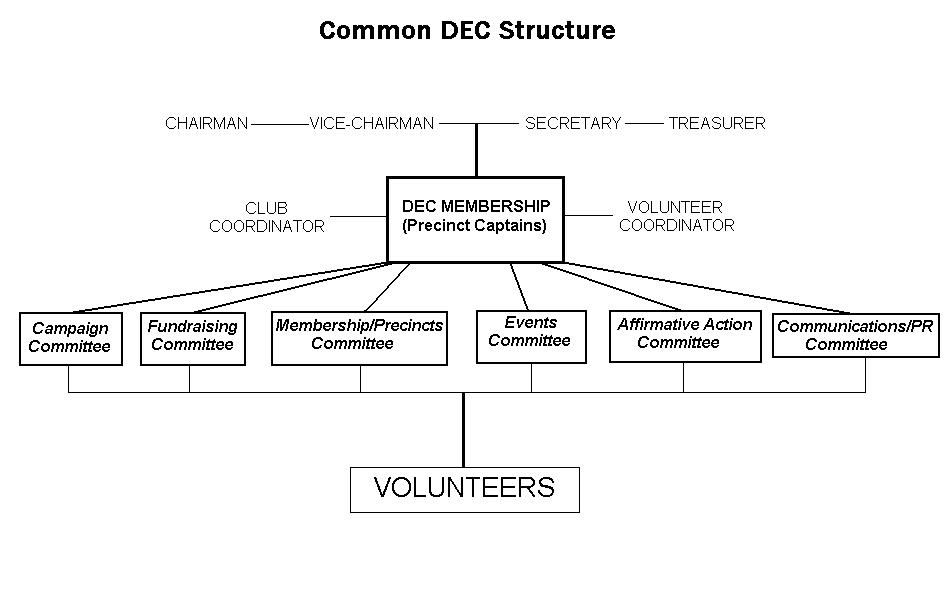 Click on the image for a larger view.
As you can see, today's DECs are completely dependent on volunteers and committees. Each of its major responsbilities has a committee dealing with the issue.
In an ideal world, all of this would flow nicely, each committee would have a group of 7-15 members who would world cohesivley to come up with specific solutions and prescriptions to the issues affecting their area of focus. Also, each committee would work with each other and arrange their agendas, operations, and plans accordingly. Designated committee members would make regular reports to the Executive Board (the top 4 elected positions) or a Steering Committee (not mentioned in this DEC model, but is used in some DECs.) The Executive Board or Steering Committee would coordinate and organize all of these committees around a few (3-5) main objectives and guide them in the same direction.
Unfortunately, this isn't an ideal world. As mentioned in my previous post, volunteers aren't terribly reliable, many lack proper training, background, or experience in the necessary fields (communications, events coordination, campaign/project management, fundraising, etc...) and have their own narrow agendas and priorities. These committees usually meet irregularly, if at all in some DECs, and even those that meet regularly usually only meet once a month. This, of course, is not enough to adequately plan and enact operations needed to unseat an entrenched Republican majority, or keeping elected Democrats well supported and reinforced.
We need large structural reforms in DECs if we are to be successful in 2006 and beyond. My next post will be on the ideal DEC structure at different levels (in small, medium, and large counties.)
Friday, February 10, 2006
Completely Volunteer-Based DECs to Professionalized DECs
Today's DECs: All Volunteers, All The Time
The vast majorty of DECs today are completely and totally volunteer based. All operations, from creating accurate voter files, to working with local campaigns, to canvassing neighborhoods, getting out the vote, and so on, are all done by volunteers.
Volunteer-based DECs generally have several committees which deal with major responsibilities of the local party. There is usually a Campaign or Coordinated Campaign Committee, a Fundraising Committee, a Volunteers Committee, et cetera. These are all run and operated by volunteers. They tend to meet once a month or irregulalry.
Volunteers are great. They are generally community activists who have a sincere and deep committment for a better future for their communities. They are dedicated, work hard when given clear and understandable goals, and will get things done if harnessed and coordinated correctly.
However, there are many reasons to believe that completely volunteer-based DECs are the DECs of the past, and that future success at the local level in local, state, and national elections are dependent on DECs evolving into what I call "professionalized" DECs.
I will discuss this in a minute, but let me detail why the current DEC system is ineffective to the needs of the present.
Why DECs Must Change
First, volunteers, with varying schedules and busy lives, are not the best folks to sustain party operations day-after-day and keep things moving in a certain direction. Also, being mostly community activists, they have their own personal agendas and ideas which they will fight for, hell or high water, and will not compromise. What happens in today's DECs is that volunteers, who once again, have their own personal agendas, get together for irregular or only monthly meetings, push and push for their ideas to get enacted, and no one goes anywhere. This goes on, month after month, with folks getting more frustrated and more frustrated, until volunteers get completely dissolusioned, and leave.
Meanwhile, what is happening to everything else? If the party has a headquarters, who is running the office, does anyone know where the party stands, or what its doing? Where is the party going? All of these issues, combined with poor and lacking leadership from above (see my previous posts entitled "The Main Ingredient for Success: Leadership" as well as "The Purpose of This Blog") create an environment of complete and confounding chaos.
Plus, volunteers and community activists are not necessarily trained for have experience in the very things they are put in charge of or are told to put together or organize.
Becoming "Professionalized"
First, let me say that I am extremely against hiring or bringing on board consultants to "rebuild" DECs. Consultants are expensive, and are not necessarily effective. In fact, many Democratic Party reformers (including myself) believe that expensive DC consultants give bad advice and are one of the main reasons why Democrats are where they are today.
By "professionalizing" DECs, I mean working with existing volunteers and activists, training, organizing, coordinating, and finally compensating them properly. This, of course, requires leadership. Some DECs have it, many don't. When it seems leadership is absent, the Florida Democratic Party (FDP) needs to step in. Regional organizers or the state DEC coordinator should step in and heavily assist the DEC in the reorganizing process, which should include professionalization.
Through the successful implementation of a recurring donor program, as mentioned in a previous post, a DEC can be receiving thousands of dollars monthly. One of the DECs first priorities with this money should be to rent, lease, or over the long term, buy a facility to house a central headquarters. I'll explain more in a previous post in the dire need for ALL DECs to have a headquarters.
The next priority for DECs with recurring donations is to hire activists with particular talents in communications, reception work, fundraising, and managerial skills. I'll discuss more in another post on what various paid positions should be.
Volunteers Still Play An Important Role
After all of this, you're probably asking yourself, "What about the volunteers, paid staff can't handle everything!" You're absolutely right, and I'm certainly not advocating the complete removal of volunteers from DECs - that would be foolish. But important, integral operations which must be kept up constantly to ensure that DECs remain a powerful political force in the community, need to be left to paid staff.
Monday, January 02, 2006
"Crashing the Gate"
Any of you who have been to dailykos.com lately know what I'm talking about here. Crashing the Gate is a new book written by kos (Markos Zuniga) and myDD.com founder Jerome Armstrong. This book promises to be a very good one in terms of analyzing the inability of the Democratic Party to adapt to the times. From the publisher, Chelsea Green:
Crashing the Gate lays bare, with passion and precision, how ineffective, incompetent, and antiquated the Democratic Party establishment has become, and how it has failed to adapt and respond to new realities and challenges.
You can get more details about the book here.
Its very good to start hearing more about this burning issue. If the Democrats in any part of the country, and especially in as important as a state as Florida, want to win, they will need to dramatically reform themselves. This begins at the local level - with the DECs.
2006 promises to be an interesting year for Democrats. Will they organize the local parties in time to win? Only Democratic party itself will decide this.
Friday, December 09, 2005
Better Fundraising Through A Recurring Monthly Donor Program
Anyone who has worked inside the Democratic Party knows that fundraising and finance are immensely critical issues.
And lets be honest, they should be. Without money to pay the bills, and eventually staff and operations, most DECs lay dead in the water.
Most DECs rely on dinner fundraisers to get the funds they need to pay the bills or other expenses. In Marion County, we raise a few thousand dollars everytime we have a fundraiser, and they're great for paying the bills for our headquarters. Unfortunately, they do little more than that - pay bills.
If DECs are to be successful, they must begin to look at alternative forms of fundraising. Before I go any further, let me say that dinner fundraisers should continue to provide basic funding for DECs, and they shouldn't be stopped. These dinners not only raise money, but also allow fellow Democrats to socialize, coalesce, and make important contacts.
The best way to constantly raise large amounts of money over a period of years is through the creation and maintenance of a recurring monthly donor program. For those who are familiar with the "Democracy Bonds" program started by Howard Dean and the DNC know what I'm talking about. A recurring monthly donor program basically allows donors to contribute a certain amount of money per month to party coffers. The difference between a "recurring" monthly donor program and your ordinary donor program is that with a recurring donor program money is automatically deducted from the donor's bank account and into the party's account. This way, donors don't have to be called up and annoyed when they forget to send their monthly pledges.
To show how effective this could be. Look at Marion County. In 2004, arguably a very hot election year, the party raised a grand total of $17,919.07. In 2005, Marion County Democrats have so-far raised $10,472.98, because of a revamped fundraising operation (a group of dedicated people have finally organized a committee and have dedicated themselves to putting on regular fundraisers.) However, consider this. If Marion Democrats could put 100 people on a recurring donor program (the minimum amount being $10 a month), the party would raise $1,000 a month, that being $12,000 a year. Put that on top of recent well-attended fundraisers and you have a real fundraising operation with serious capabilities.
Also, its good to note that there are 75,000+ registered Democrats in the Marion County. Obviously, not all are going to participate in such a program. But just a fraction of folks giving just the minimum of $10 a month, is enough to build a superparty.
Recurring monthly donor programs can be set up through Paypal.
Sunday, November 13, 2005
The Dire Need for Good Training
First of all, sorry for the lack of posts over the past 2 months. I've been pretty busy up here at UF.
One glaring inefficiency of most DECs is the lack of capable leaders and innovators. Don't get me wrong, there are plenty of willing and extremely energetic people who are members of DECs. However, as I mentioned in a previous post we have a severe lack of leadership.
I've already talked about our "defecit of leadership." In this post I'd like to discuss the need for training.
Those who move the party's arms and legs MUST have some form of training. I will post at another time what I believe to be the best structure for a DEC. These are the kinds of people who need training which the FDP should provide:
- Precinct Captains: This is first and foremost. Precinct captains must know their responsibilities and duties to the DEC and the Democratic Party as a whole. They need to learn about identifying loyal Democratic voters and recruiting them; using and retaining volunteers properly; holding house parties; conducting successful community outreach efforts; and conducting successful GOTV planning and implementation. They must also know the hopefully many tools and support that their DEC offers.
- Communications people: those who work with the media and press need to learn how to work with these folks properly; how to make relationships with reporters and editors; what to say and not to say, etc...
- Researchers: Those who do research and policy work for the party. They need to know where to access information and who to talk to to get information.
- Fundraisers and Event Planners: These folks need to be trained in planning and organizing successful fundraisers, marches, rallies, etc...
The FDP needs to make it a top priority to rebuild their DECs. One major way is to hire folks in their staff which can train willing DEC members to do these and many other needed tasks within DECs. Field organizers come to mind.
In the next post or in one down the road, I will discuss my idea for the ideal organization of a DEC. This post on training will have added meaning once you read that post. An ideal DEC cannot function without adequately trained members.
Thursday, September 01, 2005
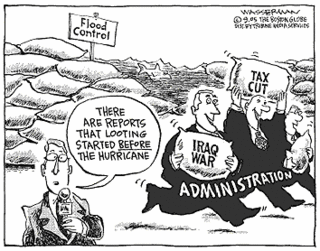
Hurricane Katrina
By now, most of you know of the extreme grief, frustration, and overwhelming destruction caused by Hurricane Katrina on our fellow brothers and sisters in Louisiana and Mississippi.
Even though this blog is dedicated to reforming Florida's DECs, I think that this is currently more important. I'll get back to blogging soon.
For now, however, lets show the world that we as Americans help our brothers and sisters in need, and that we solve our problems together as an American community.
If you can, give now to the American Red Cross:
American Red Cross
Red Cross of Southwest Louisiana
Mississippi Gulf Coast Chapter of the American Red Cross
Also, if you know someone from the area who is need of housing, moveon.org, has launched a new section of their website dedicated to finding homes for Katrina victims:
http://www.hurricanehousing.org/
Thanks,
Ray
Even though this blog is dedicated to reforming Florida's DECs, I think that this is currently more important. I'll get back to blogging soon.
For now, however, lets show the world that we as Americans help our brothers and sisters in need, and that we solve our problems together as an American community.
If you can, give now to the American Red Cross:
American Red Cross
Red Cross of Southwest Louisiana
Mississippi Gulf Coast Chapter of the American Red Cross
Also, if you know someone from the area who is need of housing, moveon.org, has launched a new section of their website dedicated to finding homes for Katrina victims:
http://www.hurricanehousing.org/
Thanks,
Ray

Saturday, August 27, 2005
Welcome DEC Leaders!
I just sent out an e-mail to all of the DEC leaders throughout Florida using the e-mail addresses at the FDP website.
Even though I've only posted two entries, let me invite you to comment on them.
If you would like to post entries on this website, e-mail me at preacherboy86@juno.com and tell me that you want to be a member. I'll be happy to send you an invite.
Also, I received many "Mail Not Delivered" messages. Obviously FDP hasn't been updating their contact info. too well. If you have any DEC contacts in the following counties, please drop me a note in the comment section:
Broward
Calhoun
Hamilton
Holmes
Levy
Martin
Monroe
Orange
Osceola
Pasco
Putnam
Taylor
Union
Washington
Your help and support are greatly appreciated.
Monday, August 22, 2005
The Main Ingredient for Success: Leadership
What many DECs lack today is good, strong, and consistent leadership. Too often but certainly not always, officers are elected and are "just passing through", not willing or unsure of how to change the system.
Unfortunately, there is no "process" on how to grow leaders in a place where there consistently has been no leadership. You need some outside help initially. It probably wouldn't be a bad idea to invest in some form of leadership/campaign training for its members.
Over time, as the party's precinct organization and community outreach efforts grow (more on these subjects in other posts), and with the party consistently training it precinct captains and interested party activists, leaders will undoubtedly emerge to not only be officers, but committee chairs, staffers, and leaders of specific efforts and initiatives.
In my limited experience, here's what I've found to be traits in good leaders, especially within DECs:
- Takes initiative, if they have a good idea, they run with it and don't stop until it is implemented or until they are absolutely convinced that the idea won't work.
- Has a lot of drive, they dig their heels in and they get to work.
- Is an innovator, they are always thinking of new ways to change the party for the better or alter current procedures or processes to keep the DEC moving along efficiently.
- Is willing to listen to others, rather than just espouse their view and disregard others' opinions.
- Is always kind to others, yet is tough when needed.
Yes, I know that it is practically impossible for one person to embody all of these traits. However, this is why our DECs must depend on groups of leaders, rather than just a single lone power. This, I believe is a common mistake in current DECs. They rely on a single person to lead everything, and then when that person leaves, things just fall apart. With groups of leaders, however, if one has to leave, there are still a group of people there who can continue to carry the party forward.
One thing is certain: a DEC cannot do very much and certainly can't even come close to being a factor in elections, if the DEC does not have a group of leaders leading.
Saturday, August 20, 2005
The Purpose of This Blog
Hello, my name is Ray Seaman. I'm currently 18 years old, a political science student at the
I started this blog in order to create a forum of ideas on how to reform Florida's many DECs so that they become an effective arm for the the Florida Democratic Party, and more importantly, an effective force of progress within Florida's many diverse communities.
Currently, many of
I hope this blog becomes a place in which current, former, and just disgruntled DEC members can come, not just to vent, but to share new ideas on how DECs can become effective.
Subscribe to:
Posts (Atom)


